USAID DEC
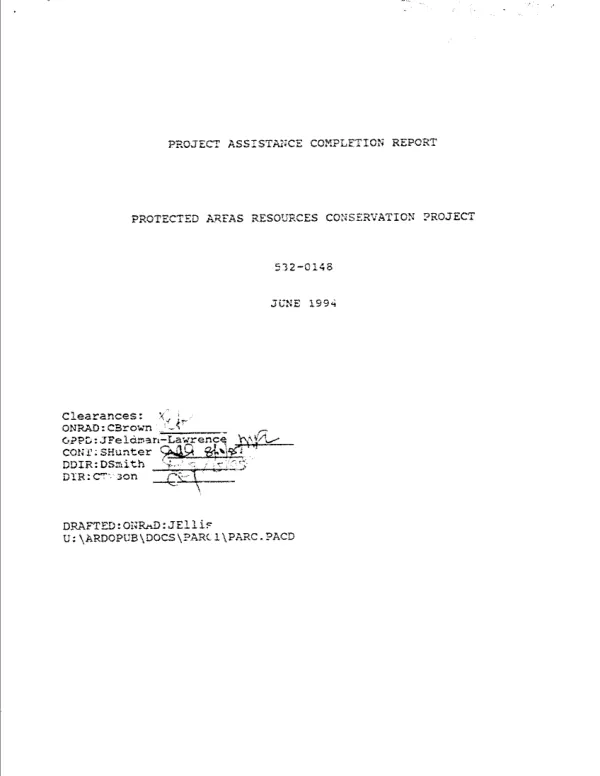
Project assistance completion report : protected areas resources conservation project
Sign inUSAID. MISSION TO JAMAICA
Project assistance completion report : protected areas resources conservation project
PACR of a project (12/90-6/94) to plan and implement two pilot national parks and to lay the foundation for a new National Parks and Protected Areas System in Jamaica (PARC project).
1994
Sign in to readA free account is required to download.
Abstract
All major targets were met or exceeded. All staff are in place, local and overseas training have been completed, and both pilot parks -- the Blue and John Crow Mountain National Park and the Montego Bay Marine Park -- were established. The parks have produced significant community benefits, institutional changes, and tangible products and have given the PARC project positive and high visibility. Regulations with sanctions were put in place for both parks and the first successful prosecutions of violations have been completed. Administrative responsibility for the Mountain Park has been moved from the Forestry Department to the Natural Resources Conservation Authority (NRCA). The project also funded a series of activities leading to the establishment of a National Parks and Protected Areas System. Specifically, a National Parks System Plan, a detailed plan of all current, proposed, and potential park sites in Jamaica, was formulated, and a National Parks Fund (currently at J$20M) was established to finance recurrent and capital costs associated with park management. The Conservation Data Center at the University of the West Indies has logged data on most of Jamaica's flora and fauna and has begun to sell information from its data base to local and international consultants. In addition, the Project Paper Supplement making Phase II a component of the DEMO project (5320173) is complete. Phase II will involve consolidation of work on existing parks, establishment of two new parks (Cockpit Country and Black River Morass), further capitalization of the Trust Fund, establishment of a National Parks Institute, and continued data collection and monitoring. The Nature Conservancy provided high-quality TA in all aspects of the project. Lessons learned include the following. (1) Protected areas programs work best when they have clear goals or visions, and a subsequent educational program to build and sustain them. (2) A long-term commitment is needed for biodiversity conservation programs that require creation and management of park systems. The project should have been designed for implementation over the longer period needed to create the legal, institutional, and financial basis for a park system and also to train and equip staff to assume full operation of a park system. (3) Demarcation and operation are not the only things to consider when establishing parks. Measures to address external threats, e.g., from pollution, should be put in place. This requires going outside the framework of a park system to engage other sectors (urban, industrial, commercial, mining, agricultural) in the process of conservation.