USAID. MISSION TO PAKISTAN. OFC. OF THE AID REPRESENTATIVE FOR AFGHANISTAN AFFAIRS
Project assistance completion report : PVO support project (306-0211)
PACR of a project (5/90-6/94) to support PVO efforts to carry out rehabilitation activities inside Afghanistan and facilitate repatriation of refugees.
1994
Sign in to readA free account is required to download.
Abstract
Nine subgrants are discussed: health programs of International Medical Corps (IMC), Mercy Corps International (MCI), International Rescue Committee (IRC), and Freedom Medicine (FM); rural assistance by CARE, MCI, and IRC; The Asia Foundation"s (TAF"s) democratic pluralism initiative; and IRC"s female education program. The PVOs have proven cost-effective, innovative, and, unlike contractors, able to leverage USAID funds to attract other support. While it is difficult to predict what their role will be in the postwar period, many have moved their operations inside Afghanistan, where they have formed working relationships with commanders and shuras (local consultative bodies), and more hope to do so. IMC"s program began as a relief operation, and had problems adapting as the war wound down. USAID had to more or less force IMC to coordinate with Afghan entities, streamline its operations, and charge user fees. In the end, IMC performed well. Lessons: (1) USAID should respond quickly and decisively to implementation problems; in this project, it converted grants to cooperative agreements, which allowed for more coordinated planning in a situation of flux. (2) Changeover of expatriate staff led to inconsistent implementation; IMC and USAID should have spent more time reviewing candidates for the senior field position. (3) Although IMC thought it impossible, revenue generation at clinics was viable and relatively painless. MCI"s medical program in some ways parallels IMC"s experience -- the NGO wished to remain autonomous in the field and resisted cost reductions. It is doubtful that many MCI facilities will be sustained, and is sad to note the PVO"s diminished interest in southwest Afghanistan after USAID gave MCI almost $11 million to work there. Lessons: (1) Independent monitoring is the only way to verify a program"s status, but this was very difficult under the conditions in Afghanistan (USAID found that 9 of 14 clinics which MCI said were active after USAID funding ceased were in fact inactive). (2) The greatest barrier to maternal/child health (MCH) care in rural Afghanistan is lack of trained female health workers; MCH success also depends on community make-up and local support. IRC provided subgrants to 12 international and Afghan NGOs, including grants for an emergency medical center, an amputee bicyclist group, providers of prosthetics, medical training organizations, an ob/gyn center, and a psychiatric hospital. There was little attempt to coordinate, promote sustainability, or focus grantee efforts, but USAID did find that NGOs can provide good service at the village level. FM trained/retrained mid-level health workers. It was able to transfer most of its program over to the Afghan Interim Government"s Ministry of Public Health, an admirable achievement given the myriad of problems encountered. Lessons: (1) It is better to use existing systems and resources than to duplicate them. (2) Transitioning is a learning process in itself. (3) Thailand was an excellent training ground, because conditions there were similar to Afghanistan"s. For a country like Afghanistan, providing medical training in a sophisticated setting with sophisticated equipment is unnecessary and may be counterproductive. CARE"s village assistance program furthered resettlement by using Food for Work (FFW) labor to build/rebuild rural infrastructure; most activities are probably sustainable because they provide cash payoffs to villagers. FFW did not adversely affect local food production. Lessons: (1) At first there was no time for planning, but implementation improved noticeably when plans were carefully made. (2) A better security system should have been devised for food shipments, which were hijacked several times. (3) Video reporting, showing field activities and food distribution, was a tremendous aid to USAID"s understanding of program implementation. (5) Cooperative agreements should be written in such a way that USAID can veto a poor chief of party. MCI"s agriculture program increased wheat production and supported orchard/vineyard rehabilitation, including infrastructure for a thriving raisin industry. Lessons: (1) MCI should have involved farmers in planning. (2) USAID provided detailed instructions on how MCI should distribute wheat and fertilizer but not on how it should spend the proceeds from sales of these commodities. (3) Unlike CARE, which had detailed technical plans, MCI left the planning and construction of FFW activities totally up to farmers, and as a result commitment was very high and outcomes were superb. (4) Farmers should have been allowed to make their own arrangements for transporting commodities. IRC"s model farm program included integrated forestry, animal husbandry, and multicropping activities. The program experienced a low survival rate for seedlings planted along canal banks, hillsides, and other deforested areas, and found that provision of expensive equipment was an invitation to theft and misuse. Beekeeping proved popular. IRC plans to privatize program activities. Lessons: (1) Curriculum standardization and the use of flipcharts to stress key messages were effective in farmer training. (2) IRC probably gave the best value of any PVO, due to low overhead (5.4%), relatively low-cost expatriate personnel, and extensive use of Afghan professionals, plus its own wealth of experience in the country. IRC"s rural assistance program awarded 99 subgrants to 7 international and 17 Afghan subgrantees. Between 1988 and 1990, more than half the grants were for emergency and survival assistance, mostly food aid. From 1991 to 1992, almost 92% were for rural rehabilitation projects. The program (which continues with European Union funding) made a significant contribution, especially through training of Afghan NGOs -- which are now well-positioned for sustainability. Lessons: (1) Train subgrantees early, instruct primary grantees in the need to prepare timely reports, define monitoring responsibilities clearly, and keep the cooperative agreement under one project (this program has been funded under 4 different projects, adding confusion). TAF"s multidonor democratic pluralism program provided grants to Afghan institutions and international PVOs to increase opportunities for the disenfranchised and improve information flow and respect for human rights. Most activities exceeded targets. Afghanistan"s political instability, however, makes the long-term financial viability of many of the grantees uncertain. Lessons learned show the need to upgrade the management capacity of Afghan NGOs, promote community participation, and avoid bureaucratic delays. Because USAID (unlike UN agencies and most NGOs) monitored activities from Pakistan, its decisions were not based on first-hand knowledge, perhaps to the program"s detriment. For IRC"s female education program, see abstract of PD-ABK-266.
Related documents
Documents in this collection
 1993
1993USAID DEC
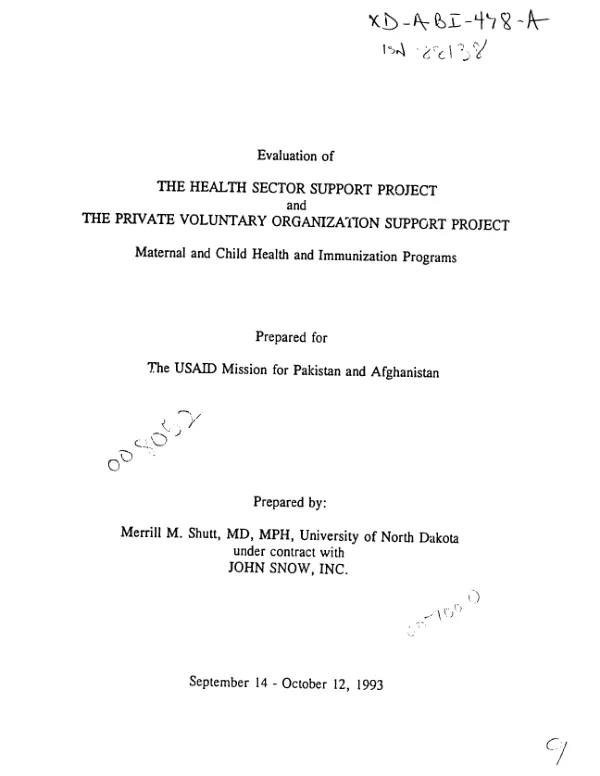
Evaluation of the health sector support project and the private voluntary organization support project : maternal and child health and immunization programs, September 14-October 12, 1993
Open record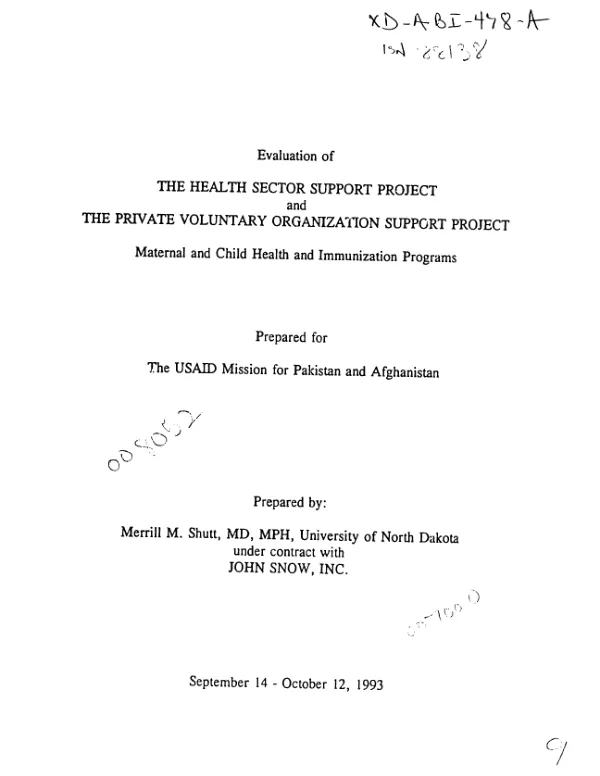 1993
1993USAID DEC
![USAID/El Salvador Hurricane Mitch reconstruction : completion report -- special objective : "reduced vulnerability of the rural poor to natural disasters in targeted areas["] (SpO 519-007)](https://covers.devme.ai/gen/44239.webp)