USAID. MISSION TO TOGO
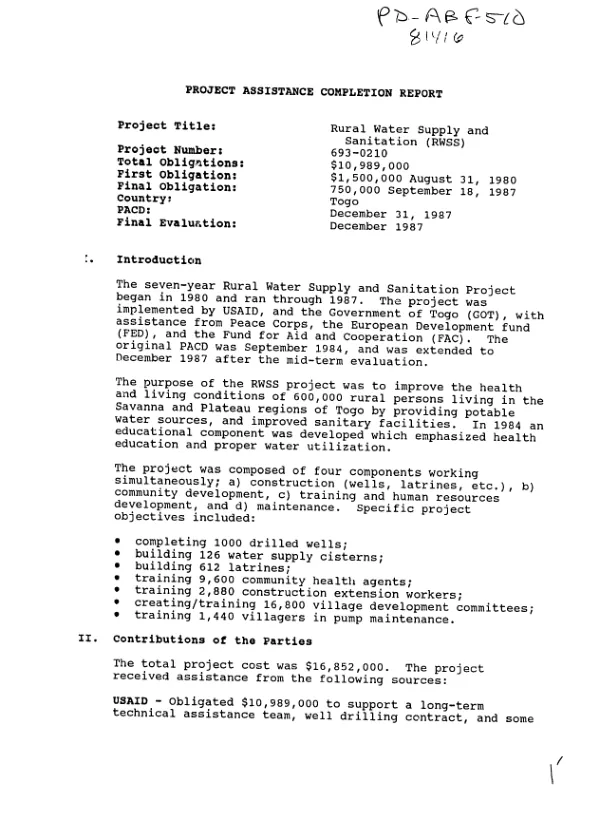
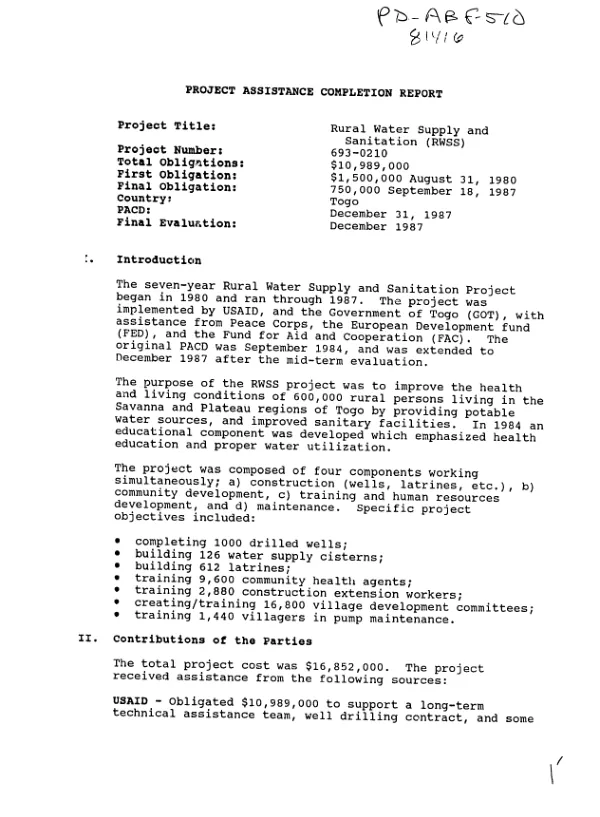
Project assistance completion report : rural water supply and sanitation (RWSS)
PACR of a rural water and sanitation project (8/80-12/87) in Togo.
1993
Sign in to readA free account is required to download.
Abstract
The project's final evaluation, conducted in February 2/88, concluded that in terms of accomplishments the project was highly successful. The 7-year project provided potable water to 864 villages with a total population of about 600,000. The construction component completed 1,048 boreholes, capped 3 springs, and constructed 256 cisterns and 473 latrines. This met or exceeded targets, except for latrines. In each village that received a well, a Village Development Committee (VDC) was established and its members trained. A slower than expected supply of some pumps resulted in some of the boreholes not being functional at the time of final evaluation. Training achievements are as follows: 8,400 health and community development agents trained; 2,000 government agents and 1,800 local workers trained in construction techniques; 10,000 VDC members trained; and 6,000 villagers trained in pump maintenance. A two-tiered system was used to recruit and train pump maintenance teams. Two people were trained in each village to handle basic pump repairs, while regional technicians were responsible for major problems and periodic visits to each village. At the time of final evaluation, the village maintenance teams were operating well, but there were not enough regional technicians to respond to problems with the pumps. The project placed considerable emphasis on the institutional development of Government of Togo's (GOT's) social affairs agencies and on VDC's to address the issue of sustainability. Sustainability was further emphasized through the project's commitment to working through existing government agencies and structures instead of creating separate project structures. This emphasis was the key to the overall project success. On average, each field agent spent the equivalent of one year's time per village in establishing committees, supervising activities, and assuring follow-up activities over the life of the project. Such a large commitment of time allocated to village contacts is necessary to ensure effective community development. About one-fourth of the total financial resources expended during this project were devoted to community development activities. This figure exceeded the commitment to health education and community development being made in comparable projects in other countries. However, the evaluation team concluded that this proportion was close to a desirable norm for rural water projects in general, given recent knowledge of the importance of community participation in water and sanitation projects. Without such commitment to popular participation, both short-term and long-term goals will be threatened. Women are a key component of any rural water and health project and should be involved in all phases of the project activities. The concept of village responsibility for pump maintenance is viable and should be continued. Villagers have demonstrated a willingness to pay for maintenance costs within reason; however they need to have all of the necessary tools and spare parts easily accessible. There was insufficient support to the pump maintenance effort beyond the village level. This support, in terms of more in-depth expertise and supply systems for spare parts, is essential for long-term viability. The sanitation component, consisting of latrine construction, is important to the total package, but project resources were insufficient to achieve desired results. Unfortunately, the type of latrine promoted by the project, while hygienic and effective, was beyond the financial means of most villagers. (Author abstract)