USAID. MISSION TO ECUADOR
Project assistance completion report : small farmer irrigation
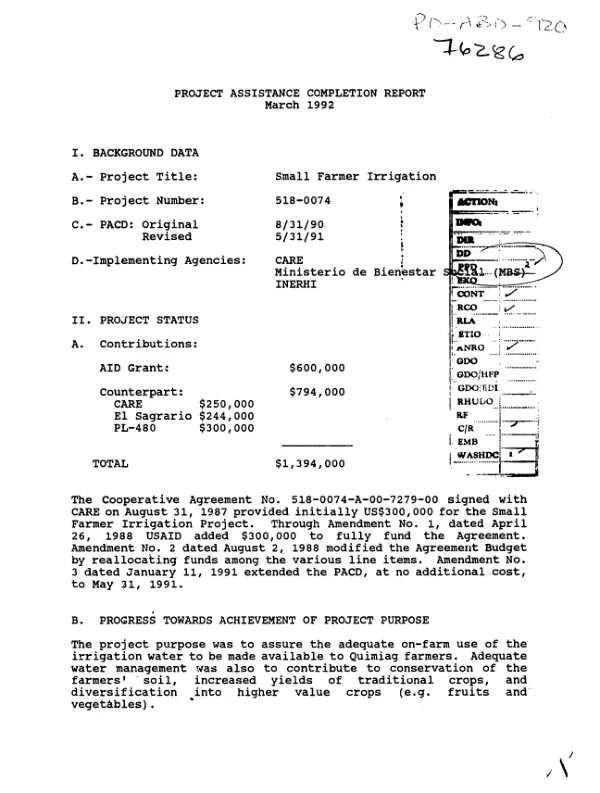
PACR of a project (8/87-5/91) to assist in the construction of on-farm irrigation systems and to provide training and credit for small farmers in Quimiag, Ecuador.
1992
Sign in to readA free account is required to download.
Abstract
Despite initial difficulties (see last paragraph, below), project objectives were widely accepted by the target beneficiaries and construction work was completed. The primary irrigation system was installed and an indigenous technician was trained to operate and maintain it. Small farmers participated in the construction of the secondary irrigation system, and 56 modules of the tertiary irrigation system were installed in the Quimiag area. The project achieved great participation in agricultural promotion through community meetings, observation trips, and the establishment of user boards (for irrigation and soil conservation). A major training effort was undertaken to increase the technical know-how of farmers and technicians. Farmers are now working closely with agricultural technicians and have made significant progress in growing labor-intensive crops (i.e., vegetables and fruit). The production of new crops, such as carrots, beets, and garlic have improved the local diet and provided additional income for farmers who sell their goods at local markets. Soil conservation activities were also widely accepted. Through community participation it was possible to incorporate into the production process land that had been left out as unproductive. Credit totalling 19.5 million sucres was provided for agriculture, livestock, and irrigation. The project initially achieved poor results due to a lack of commitment by community groups. Farmers were manipulated by local politicians and needed to be convinced of the potential benefits of TA and irrigation. Some of the problems faced should have been anticipated during the project design phase. lessons learned are as follows. (1) The responsible public entity should be committed to long-term support. (2) The various implementing agencies must be well coordinated. (3) An environment assessment should be conducted before supporting this type of project.