USAID DEC
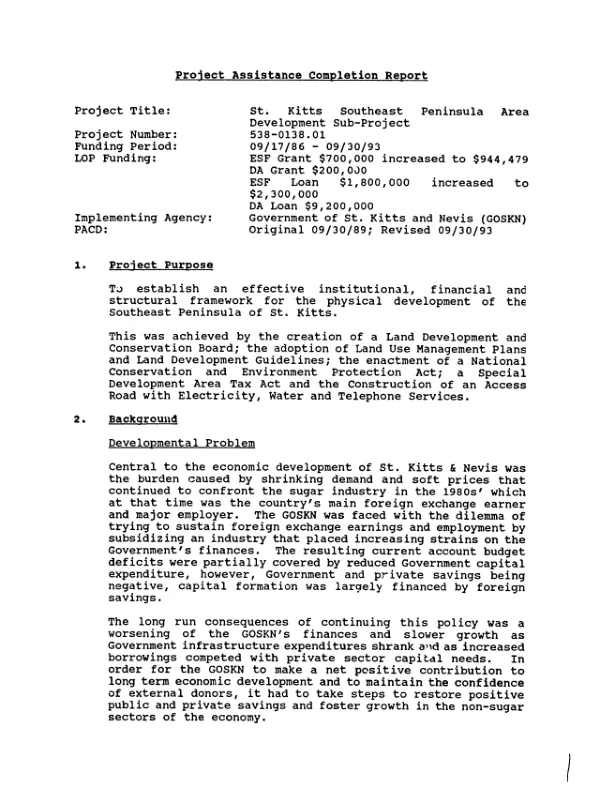
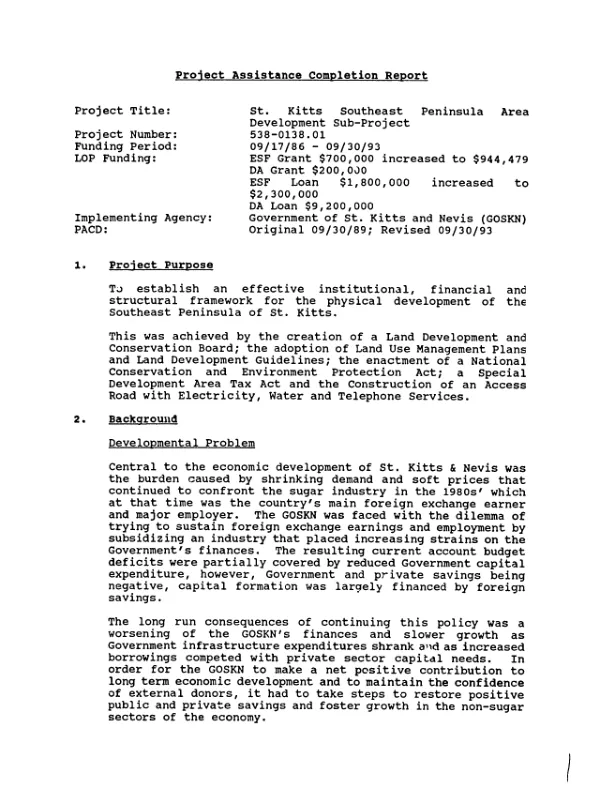
Project assistance completion report : St. Kitts Southeast Peninsula area development sub-project
Sign inUSAID. BUR. FOR LATIN AMERICA AND THE CARIBBEAN. REGIONAL DEVELOPMENT OFC. CARIBBEAN
Project assistance completion report : St. Kitts Southeast Peninsula area development sub-project
PACR of a subproject (9/86-9/93) to promote environmentally sound development of the Southeast Peninsula of St.
Archer, C. · 1993
Sign in to readA free account is required to download.
Abstract
Kitts. The project was a success. Primary achievements included creation of a Land Development and Conservation Board (LDCB); adoption of land use management plans (for erosion control and sediment reduction, wildlife/endangered species, beaches and dunes, marine resources, parks and protected areas, and reforestation) and of land development guidelines; enactment of a National Conservation and Environment Protection Act and a Special Development Area Tax Act; construction of a 6-mile access road; and installation of electricity, water, and telephone services. The LDCB has approved 6 development plans, most of them submitted by hotel and resort developers; a beach bar and grill, a dive shop, and a general shop have been constructed and are operating. Tax revenues have been used for road maintenance and other conservation services, and the project has already generated employment, including that from beach vending. The project has also succeeded in raising the environmental awareness of the people in St. Kitts and Nevis to an unprecedented level, resulting in the formation of a national association that monitors and lobbies for environmental protection and that has already prevented one developer from degrading the peninsula's ecosystem. Finally, the project has become a case study that is used by environmental educators throughout the Eastern Caribbean. The following lessons were learned. (1) Despite the project's concern about the environmental impact of development, there were insufficient funds to examine the engineering design of the road, which had the potential to affect the environment more than any other project activity. Once road construction was started, it was discovered that the substrata predictions were completely wrong, and the road had to be redesigned. However, there was no time to investigate potential problems with the redesign. (2) All relevant personnel should be involved in the project from the design stage. In this project, not only was the environmental monitor not involved in project design, but the environmental firm involved in designing the project was not the same one chosen to monitor construction. (3) The project's timeframe seems to have been chosen arbitrarily. Enough time was not allowed, for example, to help the LDCB implement the environmental protection program, which was only able to begin after road construction was completed. (4) Although funds were allocated for project evaluation and financial oversight, there were no plans to ensure that regular audits, which would have been helpful to the project officer, would be carried out.