USAID DEC
Project assistance completion report : Swaziland training and institutional development project
Sign inUSAID. MISSION TO SWAZILAND
Project assistance completion report : Swaziland training and institutional development project
PACR of a project (5/90-5/96) to strengthen Swazi management capacity in the public and private sector and upgrade training institutions that support private sector growth (STRIDE project).
1996
Sign in to readA free account is required to download.
Abstract
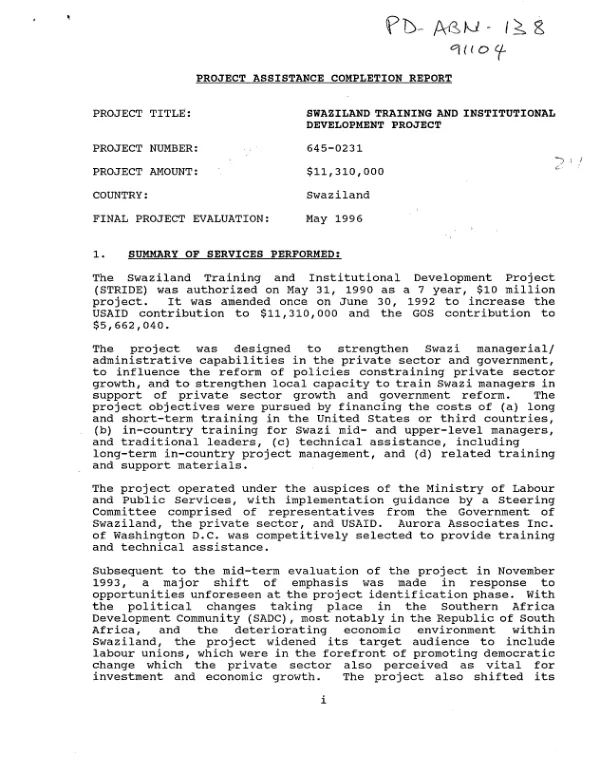
Subsequent to the 11/93 mid-term evaluation, a major shift of emphasis was made in response to political changes in the Southern Africa Development Community (SADC), particularly in South Africa, and the deteriorating economic environment within Swaziland. The project widened its target audience to include labor unions, which were in the forefront of promoting democratic change -- which the private sector also perceived as vital for investment and economic growth. It also shifted its training strategy by bringing together large delegations of participants to examine topics such as industrial relations, governance, economic productivity, and human resource competitiveness. Achievements exceeded targets. A total of 52 Fellows completed academic participant training and resumed employment in Swaziland, the majority of them in positions where they could apply their training; 78% of the Fellows studied business and 42% were women. The Swaziland Institute of Management and Public Administration (SIMPA) conducted 23 Public Sector Management Program (PSMP) workshops for more than 1,000 senior civil servants, with priority to those serving the private sector. STRIDE also funded two 40-person delegations to civil service reform conferences in the Republic of South Africa; without this support, the reform momentum unquestionably would not have been maintained. Other training included workshops on productivity (one led to a tripartite resolution to create a Swaziland National Productivity Center); training for Community Development staff in preparation for traditional leadership training; and the first ever Budget Development and Analysis workshop, conducted by SIMPA and attended by 90 Parliamentarians. Although the strengthening of SIMPA was not originally envisaged, the project's positive experience with SIMPA after the 1994 appointment of a very forward-looking Principal led to a cooperative agreement between SIMPA and Technikon Southern Africa for the purpose of strengthening SIMPA's capacity to conduct training of elected leaders at the urban government and Parliamentary levels. Cal Poly upgraded commerce programs at the University of Swaziland (UNISWA) and Swaziland College of Technology (SCOT) by providing training in teaching methods and computers along with MBA training for four UNISWA staff and B.S. training for one SCOT staffer. In addition, an entrepreneurial course was established at SCOT and a small business development center at UNISWA, and Cal Poly helped to establish and refine viable internship programs at both institutions. The 5/96 final evaluation noted that the project had become a major vehicle for promoting national dialogue and political change in Swaziland. In addition to the lessons learned noted in the final evaluation (PD-ABM-945), the project showed how a training project begun in a traditional mode can be refocused as needed to support a very different strategy of achieving Strategic Objectives. Such flexibility in design, which provides project management the opportunity to respond to major changes in the environment, is a critical feature of any successful development assistance effort.