USAID DEC
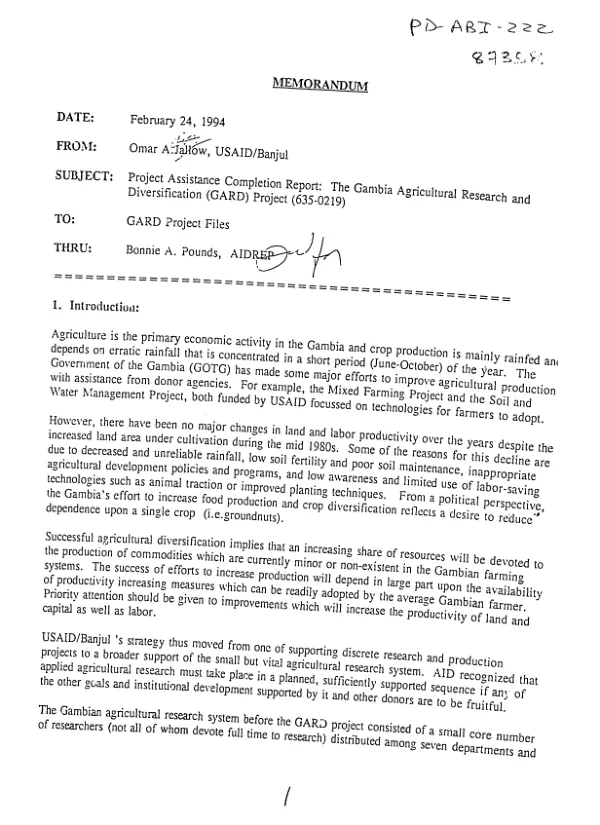
Project assistance completion report : The Gambia agricultural research and diversification (GARD) project (635-0219)
Sign inUSAID. MISSION TO THE GAMBIA
Project assistance completion report : The Gambia agricultural research and diversification (GARD) project (635-0219)
PACR of a project (6/85-12/92) to help The Gambia develop a unified agricultural research system, linked to extension and responsive to farmers' needs.
Jallow, Omar A. · 1994
Sign in to readA free account is required to download.
Abstract
The University of Wisconsin was the implementing entity. The project was a success on several counts. An Agricultural Research Management System -- consisting of a National Agricultural Research Board, a Program Budgeting System, a task force, and a technical secretariat -- was created, and well-focused research has been carried out, including soil calibration tests; a plant nutrient survey of maize, millet, and groundnuts; on-farm trials of cereal varieties; and preparation of a cropping system map. In addition, the project facilitated meetings between Gambian scientists and regional, national, and international agricultural research centers (although no formal research contracts resulted), and developed a Farmer Innovation Technology Testing program which was accepted by Gambian agricultural organizations, but which has not reached its potential because of the lack of support from researchers, DAS (unidentified acronym), and NGOs. Training included 12 B.S. and 7 M.S. degrees (of the 19 participants, 3 were female, and 15 returned to the Ministry of Agriculture); short-term training, including regional training for research scientists and U.S. technical training for Gambians; in-service programs; networking programs; and in-country training. Training topics included agroforestry, animal traction, livestock research, agricultural statistics, crop research, soils, agricultural extension, and research-extension linkages. Finally, eight promotional programs were developed in collaboration with NGOs. These NGOs cooperated in disseminating and promoting groundnut seed dressing, use of row markers, use of cowpeas and sesame in nutritious meals, and ram fattening. The ram fattening campaign in Tobaski was particularly successful and resulted in the development of annual livestock shows and increased ram sales. In sum, the project made considerable progress in achieving its goals of institutionalizing national agricultural research. It tested, generated, and promoted improved crops and livestock technologies that meet farmers' needs and expand and diversify the agricultural economy. The following lessons were learned. (1) The Program Budgeting System (PBS), when fully operational, will allow USAID/G to monitor counterpart contributions. (2) Implementation and evaluation are easier when the contractor and A.I.D. have the same interpretation of the project purpose. (3) Contractors should be familiar with A.I.D. procedures and regulations, and with the contract's terms and conditions; the complete text of contract clause attachments should be made available to the contractor at the start of the project. (4) Reporting of local, project expenditures should be accurate, timely, and in accordance with A.I.D. policies and procedures; an inventory management system with checks and balances should have been instituted earlier in the project. (5) An agricultural research management system that includes end-user participation can provide farmers with useful technologies. (6) Farmers will readily adopt new technologies if their relevance has been proven and incentives for their use are provided. (7) Farmer constraints should be identified through linkages among researchers, extensionists, and farmers. Prioritization of research depends on this identification, as well as on the efforts of a multidisciplinary team of scientists, administrators, and policymakers. (8) For a new system like PBS to have a lasting effect, high-level support must be present in the recipient country. (9) Institutionalization of an agricultural research program can be facilitated by the support of both the private and public sector. (10) Relevant training reinforced by job opportunities and incentives for returning trainees is an important element of capacity building.