USAID DEC
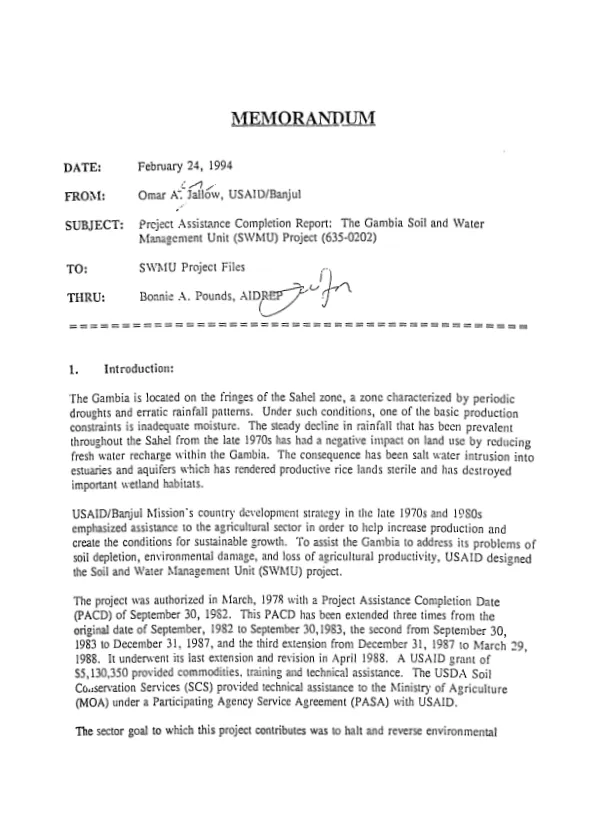
Project assistance completion report : The Gambia soil and water management unit (SWMU) project (635-0202)
Sign inUSAID. MISSION TO THE GAMBIA
Project assistance completion report : The Gambia soil and water management unit (SWMU) project (635-0202)
PACR of a project (3/78-6/91) to establish a soil and water management unit (SWMU) in The Gambia to combat environmental degradation, increase and stabilize agricultural production, and deliver improved extension services to farmers.
Jallow, Omar A. · 1994
Sign in to readA free account is required to download.
Abstract
Despite a slow start-up, the project"s purposes were for the most part achieved. Establishment of the SWMU within the Ministry of Agriculture has increased the number of Gambian villages receiving agricultural services. Several soil and water conservation structures and measures were constructed and/or implemented, and the unit developed a program to train farmers in conservation techniques. Efforts to halt or reverse environmental deterioration included reclamation of 780 ha of lowland rice-growing area and 1,631 ha of upland conservation area and creation of watersheds at eight villages, resulting in fourfold increase in land under cultivation at these sites. The SWMU also screened for rice varieties adapted to saline conditions, and conducted soil surveys on 24,000 ha and established tree nurseries in 10 villages. Project activities reduced or eliminated drought conditions by increasing fresh water infiltration, and significantly reduced siltation. SWMU"s efforts to control erosion and saltwater intrusion and to introduce improve varieties and agronomic practices not only increased yields, but increased the total production area without undue damage to the environment. More than 20,000 farmers in 78 villages have benefited from lowland and upland rice cultivation rehabilitation work, and their food productivity has increased by well over 50%. Women benefited most in lowland rice projects while men benefited most from upland conservation. The SWMU also initiated development of a National Natural Resources Policy document which, however, was not accepted because it did not cover environmental issues outside water and soil conservation. Nonetheless, the document was used in preparation of the Gambia Environmental Action Plan (GEAP). In addition, the SWMU hosted a number of international and national seminars; published 3 supplemental readers on the environment and natural resources conservation for use in primary schools; developed 5 operational manuals; developed a soil and water conservation program for Gambia Technical College; and produced a video illustrating the history of the project. Eight persons received B.S. degrees, 6 received Associate degrees, and 13 Unit staff attended 19 U.S. training programs. Nearly 75% of participants trained under the project returned to the country and are working at the SWMU. The SWMU"s sustainability is doubtful, however; the Government of The Gambia (GOTG) has provided only salary costs, and no other support (e.g., for fuel and vehicle maintenance). On the positive side, the SWMU has developed a political base by demonstrating its value to farmers. This support is evidenced by the fact that SWMU was commissioned to create a Soil Conservation District in The Gambia, that over 50 villages are demanding services from the SWMU, and that farmers are willing to contribute their labor and other resources to accomplish conservation activities. TA provided by USDA was less than expected due to costs; no short-term TA was provided in soils, agroforestry, or range management, monitoring, and evaluation; very little was provided in monitoring and socioeconomic impact research, and in computer-assisted data collection and analysis. The following lessons were learned. (1) Farmers will readily adopt technologies if their relevance has been proven and if incentives are offered for their use. (2) Farmer problems should be identified via a participatory mode. (3) High-level support and involvement of many actors at various levels was needed to institutionalize SWMU. (4) Appropriate training (i.e., offshore, followed by on-the-job) is an important element in capacity-building. (5) To succeed, an agriculture and natural resource project should operate within the labor, time, and capital constraints of participating farmers. (6) Gambian villages are willing to work together for social well-being if they get the right message. (7) The benefits of conservation technology can be achieved and sustained only if its users have ongoing access to technical advice. Once an institution is created, it must have the resources needed to provide ongoing technical advice. (8) National institutions, which are essential for designing technically complex conservation infrastructure, require a long time to develop and mature.