USAID. MISSION TO BURKINA FASO
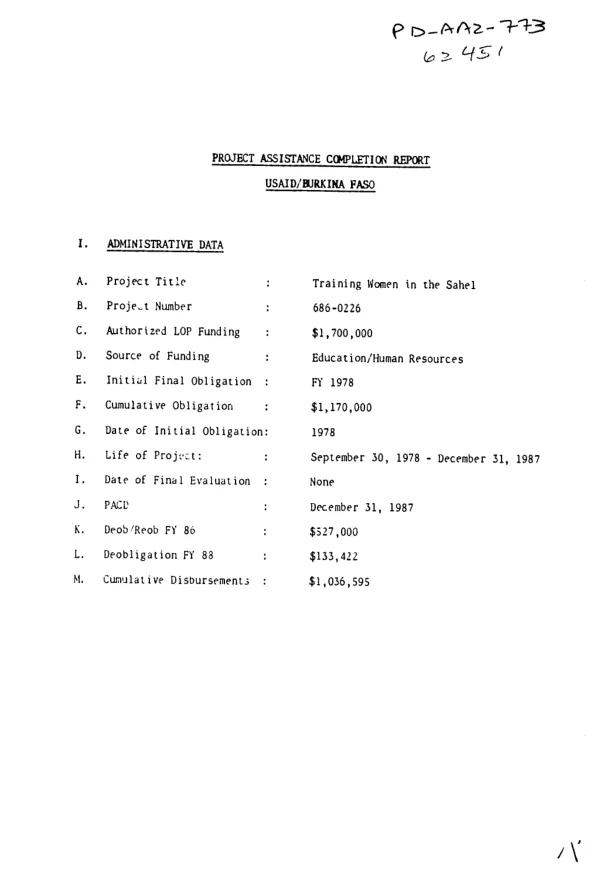
Project assistance completion report : USAID/Burkina Faso
PACR of a project (9/78-9/88) to train extension agents and female village paraprofessionals to help women in Burkina Faso's Sahelian regions to develop labor-saving technologies, income-generating activities, health and hygiene programs, and local-language literacy.
Sign in to readA free account is required to download.
Abstract
The project has had a two-cycle life. During the first period (9/78-9/83), tremendous management difficulties resulted in the achievement of only 50% of program and financial goals. These problems were mainly the result of an approach which centralized administrative responsibilities under the Ministry of Social Affairs (MSA), while implementation was carried out by a provincial agency. One of the project's major outputs, the construction of a women's training center at Dori, was abandoned, due to a combination of MSA delays in extending the original invitation for bids, the lack of local business response to the invitation for bids, MSA delays in submitting building plans to USAID/B for approval, and the suspension of project funds by USAID/B during the last 9 project months. Associated with poor management was the MSA's inability to establish and maintain project monitoring and evaluation systems on the national, regional, and village levels. A credit fund set up to finance gender-specific income-generating activities was decapitalized after a short period of operation, due to management problems. Another major cause of failure was the involvement of local authorities, who misinterpreted the project as a rural credit effort rather than a training effort. Despite its general poor performance, the project was credited with: training in the areas of animation, nutrition, hygiene, maternal/child health care, home economics, and literacy, as well as management for paraprofessionals, extension agents, and project personnel; carrying out home economics and agro-pastoral activities; and provision of equipment. After a project suspension from 10/83 to 11/85, an agreement was reached with the Ministry of Family Welfare and National Solidarity (MOFWNS) to finish the construction and equipping of the Dori women's training center, and provide limited training. However, the MOFWNS did not carry out implementation responsibilities in a timely manner. The center design was completed in 8/86 instead of 1/86, and even with a 3-month extension, only 90%-95% of the center was completed. Although the center is functioning in this state and has assisted in training and in establishing village gardens and 4 grain mills, project impact was lessened by the suspension. Development of a core of paraprofessionals was not fully achieved and programs such as local language literacy were picked up by larger national programs and dropped by the project.