USAID. BUR. FOR LATIN AMERICA AND THE CARIBBEAN. REGIONAL DEVELOPMENT OFC.
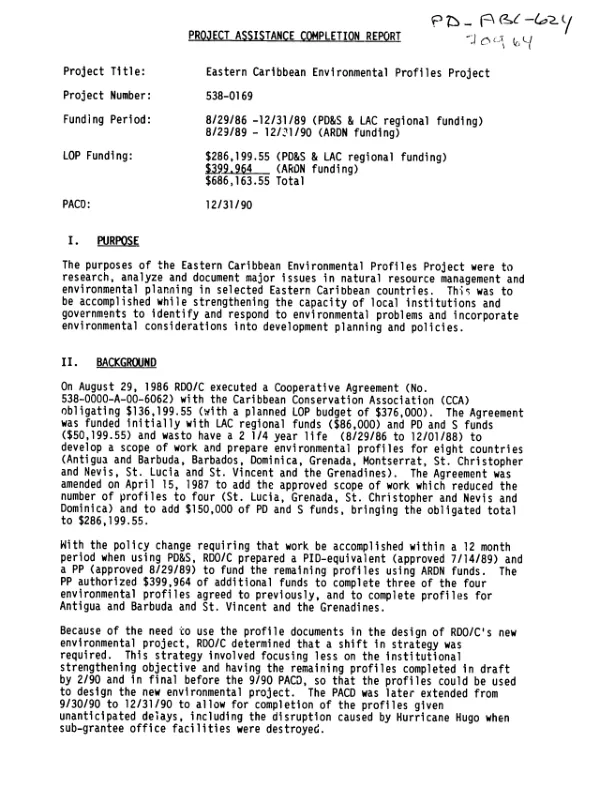
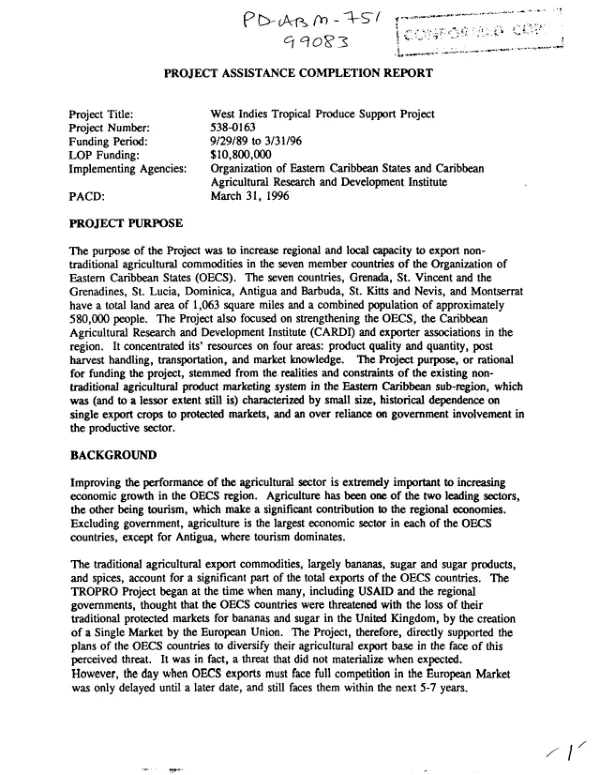
Project assistance completion report : West Indies tropical support project
PACR of the West Indies Tropical Produce (TROPRO) project (9/89-3/96) to help member countries of the Organization of Eastern Caribbean States (OECS) to increase non-traditional agricultural exports (NTAEs).
1996
Sign in to readA free account is required to download.
Abstract
TROPRO was a success. It helped to increase export revenues by shifting the market thrust from the low-value United Kingdom market to the higher-value U.S. market and the growing intra regional market. In addition, new markets and new products were identified as a result of TROPRO-supported trial shipments, and the quality of export products was improved through the adoption of OECS grades and standards and the distribution of posters and commodity specifications. Sustainable improvements in packhouse operations were made on five islands due to extensive TROPRO inputs of training, packhouse equipment, and crop guideline posters. As a result, the majority of OECS exporters now pack to international standard weights in product-appropriate cartons. Since 1996, new commercial pre-cooling facilities have been available to exporters in Antigua, Dominica, Grenada, St. Lucia, and St. Vincent. Additionally, national exporters associations have been formed (though they are still in the early stage of development), and an increasing number of exporters are either becoming producers or are expanding their production, confident of their ability to retain their export markets. The project has also been a powerful agent for lowering air and sea freight rates to extra-regional markets. A strategy of providing intensive assistance to selected commodities -- from the variety selection stage through to marketing -- has had a strong impact. Hot peppers and mangoes are two such crops which have seen phenomenal increases in export volumes and values. OECS's Agricultural Diversification Coordinating Unit (ADCU) has been strengthened. Staff were trained in the management of fresh produce export marketing, and in use of the marketing information system, which ADCU will continue to use to disseminate marketing information to exporters and producers. The following lessons were learned. (1) Project management was improved by developing a consolidated implementation unit consisting of grantees, accounting staff, and the TA team. During the first 3 years, the major implementors were scattered over four different islands. (2) Earlier support should have been provided to high-value crops for the regional market, not only because of untapped opportunities, but because they faced the same variety and quality obstacles as in extra-regional markets. Even maintenance of regional market share in ethnic produce is being eroded now by high-quality suppliers. (3) Training was initially handled through seminars in which most participants were from public support institutions, and learning was infrequently transferred to the private sector. Emphasis changed over time to a one-on-one approach, e.g., utilizing postharvest specialists working alongside packhouse staff to carry out improved grading procedures. These direct interventions produced much better results. (4) A "rollover" fund established by the project to enable exporters to pay farmers and purchase inputs before receiving payments from importers was only partially successful, primarily because guidelines for accessing the fund were not always applied, resulting in some misuse, and also in rejections of some deserving requests. However, several successful trading relationships (in hot peppers, Asian vegetables, and mangoes) were initiated as a direct result of the fund. (5) Liaison with the Ministries of Agriculture improved when agricultural diversification officers were appointed within the ministries to directly work with the project. This move should have been made much earlier.
![Project assistance completion report [: family planning, information, education, communication and training]](https://covers.devme.ai/gen/10093.webp)