USAID DEC
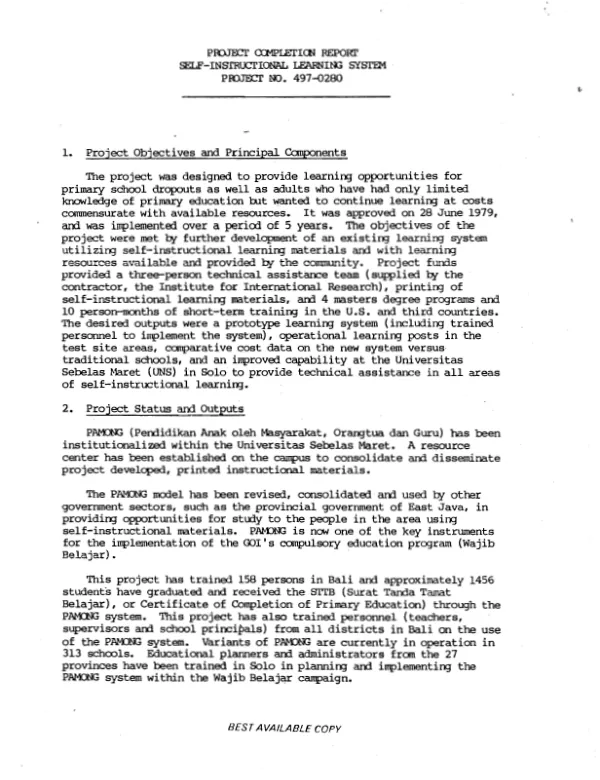
Project completion report : self-instructional learning system, project no. 497-0280
Sign inUSAID. MISSION TO INDONESIA
Project completion report : self-instructional learning system, project no. 497-0280
Presents final Mission report (6/79-1984) on a project to help the Government of Indonesia (GOI) develop a self-instructional learning system for primary school dropouts and adult learners.
1985
Sign in to readA free account is required to download.
Abstract
A prototype teaching-learning system, called Pendidikan Anak oleh Masyarakat Orangtua dan Guru (PAMONG), was developed at the Universitas Sebelas Maret (UNS), and a resource center was established on campus to disseminate PAMONG materials. Training teams, materials, manuals, and implementation guides were also developed and tested, and a formative evaluation process was developed allowing for the integration of various PAMONG programs into a coherent whole. PAMONG has become a key instrument in the GOI"s Wajib Belajar (compulsory education) program, it has been adapted and utilized by other GOI sectors (such as the provincial government of East Java), and variants of PAMONG are in operation at 313 schools, including UNS, where the system has become an accepted method of instruction. Some 1,456 students have received a Certificate of Completion of Primary Education through the PAMONG system. The project provided M.S. training to four persons and 10 person-months of short-term U.S. or third-country training. It also trained 158 teachers, supervisors, and school principals in Bali in use of the PAMONG system; educational planners and administrators from all 27 provinces have been trained at UNS to utilize PAMONG within the Wajib Belajar campaign. Lessons learned are: (1) since static empirical models are seldom suitable to all locations in a country, approaches to educational innovation must be flexible, dynamic, and capable of change as circumstances warrant; and (2) research and development must be carried out simultaneously with institutionalization efforts at both local (implementation) and policy levels. At operational levels, innovations should be implemented via existing infrastructures and institutions; at higher levels, policy should be continuously aligned with accruing field experience. The project worked with provincial and local education units from the beginning, allowing these units to initiate their own dissemination activities.