USAID. MISSION TO MOROCCO
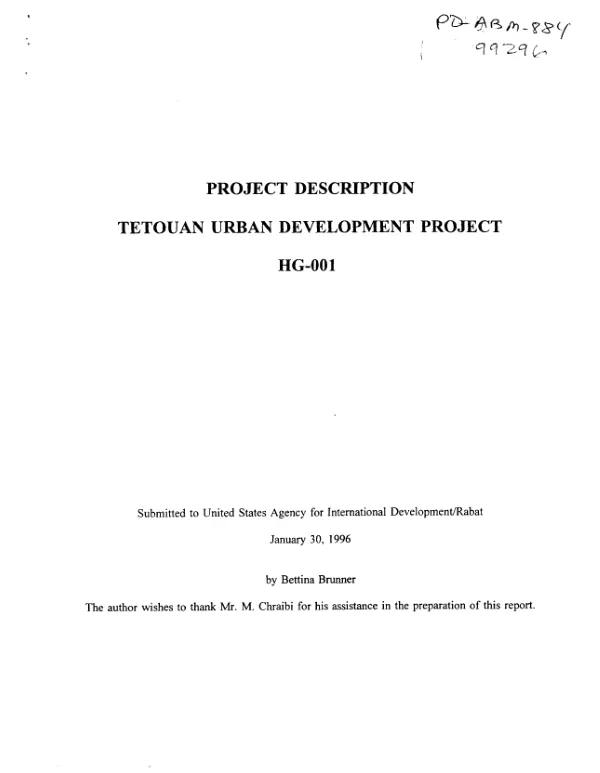
Project description : Tetouan urban development project, HG-001
Final evaluation of a housing guaranty (HG) pilot project (4/87-12/95) to upgrade and legalize clandestine neighborhoods in Tetouan, Morocco.
Brunner, Bettina · 1996
Sign in to readA free account is required to download.
Abstract
The complementary TA project (6080194), aimed at building the institutional capacity for housing industry decentralization, has been evaluated separately. After a slow start, mainly due to the project's complexity, construction proceeded relatively smoothly. The first major activity, construction of 200 low-income housing units in the Dersa-Samsa neighborhood for inhabitants displaced by demolition, was completed by 12/91, and as of 9/93, 95% of the physical upgrading activities, including sewerage, roads, potable water, and electricity had been completed; the main thoroughfare through Dersa-Samsa was also completed by that time. However, beneficiaries' payments are well below targets, due to land registration problems and political changes. In the sites and service zone, about 95% of the physical work is completed. Work in the Zone d'Amenagement (ZAC) began in 1991, but there has been little activity on this component (which would supply infrastructure to private land to generate cross-subsidies for Dersa-Samsa) for the last 4 years, due to the newness of the concept, the lack of national implementing legislation, and a lack of interest on the part of the private sector; as a result, low-income units in the upgrading zone have not been subsidized. The off-site infrastructure component also experienced a slow start-up. In 1992, under project 6080194, a U.S.-Moroccan engineering consortium began work on a Sewerage Master Plan for Tetouan; all environmental assessments and construction have been halted awaiting completion of the technical studies for the Master Plan. Overall, the project has left the Government of Morocco in a much better position to plan urban development activities by showing very clearly what works and what does not. The reasons for success or failure of a given component are complex, and are often due more to political or social reasons than to a flaw in project design. While implementation was sometimes slow, considering the enormous institutional strengthening that had to take place in order for any earthmoving could begin, these delays should not be considered excessive. The impact of the project has been enormous, as evidenced by the following developments. (1) According to reports by the National Upgrading Agency (ANHI) and Community Infrastructure Fund (FEC), 29 cities have neighborhood upgrading efforts underway or planned, most notably in Meknes and Agadir. While Tetouan's model is the most ambitious and none have incorporated Tetouan's cost recovery system, it has nonetheless had a major impact on urban policy in Morocco. (2) Tetouan Urban Community and other entities in the region have created a "syndicat de communes" in conjunction with the Regional Public Utility Agency (RDE) to plan future regional sewage needs. (3) Because of cost recovery problems experienced in the Tetouan project, the FEC no longer allows beneficiary payments as the major component in loan repayment plans. (4) USAID HG-003 and HG-004 were designed following lessons learned in the Tetouan pilot project. (5) In light of cost recovery in Tetouan, other communities are using methods such as no payment/no sewer hookups, linking sewer payment to the water supply. On the social level, the project has been an overwhelming success. Tetouan's densely populated hillsides generate health and environmental problems (e.g., water-borne diseases, wastewater runoff, mudslides). The Tetouan authorities made the decision that infrastructure improvements could not wait for informal neighborhood residents to come around, and the health and environmental situation his vastly improved.