UNIVERSITY OF ARIZONA
Project evaluation - ICRISAT/MALI
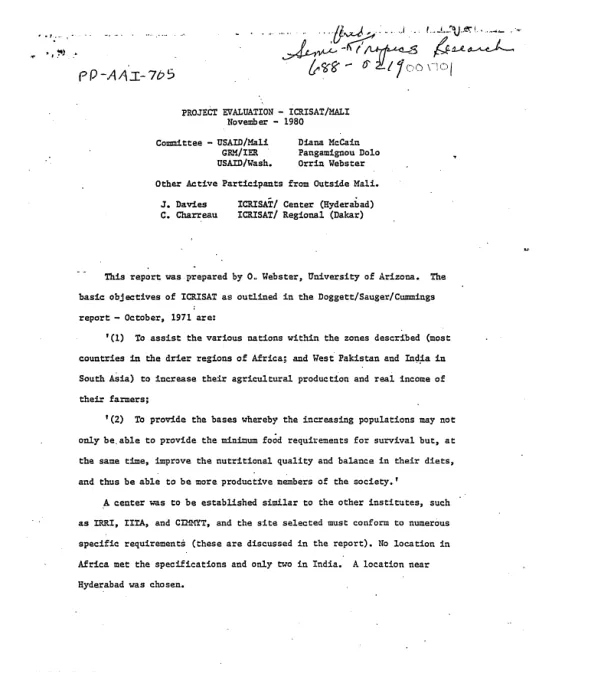
Evaluates project to establish a regional office of the International Crops Research Institute for the Semi-Arid Tropics (ICRISAT) in Mali.
Webster, O. · 1980
Sign in to readA free account is required to download.
Abstract
Evaluation covers the period 6/79-11/80 and is based on site visits. Development of ICRISAT/Mali is progressing well with facilities in place and research, training, and extension efforts underway. Two laboratories and other support buildings have been built at the multidonor-funded Malian Semi-Arid Zone Research Center near Cinzana. Research emphasis is on improved varieties of sorghum and millet and on intercropping of these grains with cowpeas. The two chief staff members are highly qualified and have a harmonious relationship with the Malian Government. Training of local staff is proceeding at five field stations in Sotuba, Cinzana, Baramandougou, Barbe, and Kopor as well as at ICRISAT/India and will eventually reduce the need for supervision. Finally, extension efforts are underway with farmer demonstrations conducted at the five training stations and with over 60 field tests completed in 1980 under the Semi-Arid Food Grain Research and Development Project. Regarding sorghum research, ICRISAT/Mali staff have surveyed local farmers' needs, identifed varieties resistant to witch weed (striga), developed a useful micro-technique for testing sorghum quality from a single head, and investigated the potential use of hybrids. Research showed that elite millet germplasm is not transferable from other countries but must instead be developed through inbreeding of local stock; plans are being made for testing and possible release of a variety of finger millet, Eleusine Coracana. Farming systems research has included intercropping pigeon peas with other crops and conducting toposequence trials. Future farm systems research will likely include rotations of planting dates, cropping sequences, and plant populations and the use of chemical fertilizer.
Related documents