USAID DEC
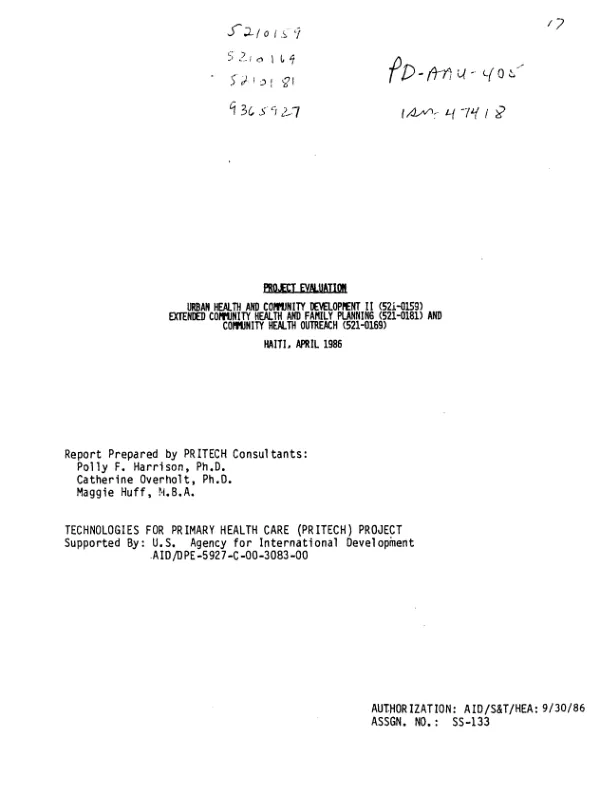
Project evaluation : urban health and community development II (521-0159), extended community health and family planning (521-0181) and community health outreach (521-0169)
Sign inMANAGEMENT SCIENCES FOR HEALTH (MSH)
Project evaluation : urban health and community development II (521-0159), extended community health and family planning (521-0181) and community health outreach (521-0169)
Evaluates three private sector health projects in Haiti: the Social-Medical Complex of Cite Simone (CMSCS) and two umbrella-type projects implemented by the Association des Oeuvres Privees de Sante (AOPS).
Harrison, Polly F.|Overholt, Catherine|Huff, Maggie · 1986
Sign in to readA free account is required to download.
Abstract
External evaluation covers the period through 4/86 and is based on document review, site visits, and interviews with project and mission personnel. AOPS I & II and CMSCS have been successful on both programmatic and project levels. On the programmatic level, the projects have helped to restructure attitudes towards health care delivery in Haiti; they have provided experimental feedback to the public sector, produced structural changes in AOPS grantee institutions, and elevated consciousness about provider accountability. AOPS, in particular, because of the flexibility with which it has funded and implemented subprojects (SP's), continually rolling over lessons learned into successive SP's, has in effect acted as a large operations research (OR) program. On the negative side, costs are an issue both for sustainability and replicability (especially with reference to project/SP size and adaptability to the public sector). While CMSCS has increased its revenue base through patient, prescription, and school fees, no distinct method of reducing AOPS' major expense of providing a doctor as technical leader and SP manager has been found. On the project level, achievements have been excellent. AOPS is well ahead of schedule: 25 SP's are active, with most functioning fairly well. Some 352,300 (vs. 500,000 targeted) children and pregnant women have been vaccinated. While family planning promotion is proceeding less smoothly (due partly to ideological resistance in individual institutions and partly to inadequate health worker training at all levels), contraceptive prevalence rates in four SP areas are above the national average. Progress, though less significant, has also been made in child health care areas such as growth monitoring and nutrition education; little has been done regarding oral rehydration therapy (ORT). CMSCS has achieved its targeted coverage and is improving the number and quality of its preventive and curative services. For example, the number of prenatal visits at CMSCS has risen to 5 (vs. a WHO norm of 3) and, unlike AOPS, CMSCS has been very successful with ORT. CMSCS is making appropriate adjustments to accommodate its greatly increased size and comprehensiveness. While there is no OR strategy as such, a research and evaluation unit has been set up and variety of OR activities have been undertaken.

![Evaluation of the Agence d'Approvisionnement des Pharmacies Communautaires [Community Pharmacy Supply Agency] (AGAPCO), Haiti](https://covers.devme.ai/gen/8266.webp)