USAID DEC
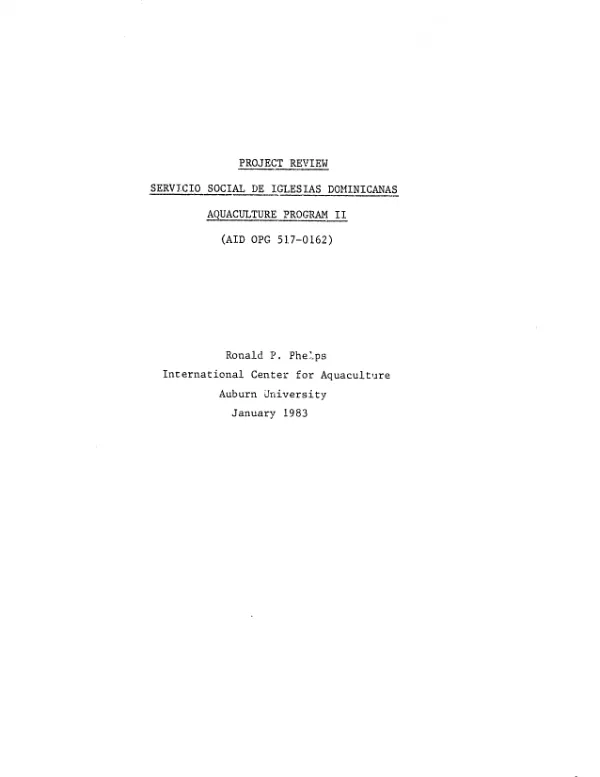
Project review : servicio social de iglesias Dominicanas aquaculture program II (AID OPG 517-0162)
Sign inAUBURN UNIVERSITY. INTERNATIONAL CENTER FOR AQUACULTURE
Project review : servicio social de iglesias Dominicanas aquaculture program II (AID OPG 517-0162)
Evaluates project to increase fish production in the Dominican Republic.
Phelps, Ronald P. · 1982
Sign in to readA free account is required to download.
Abstract
Special evaluation covers the period through 12/82; no methodology is noted. Considerable progress has been made during the project's first year. An additional 37 ponds (used for demonstrations, training, and fingerling production) were constructed, economic research (on farmer characteristics and fish production costs) is underway, and carp fingerling availability has improved (although there are still problems in having sufficient quality tilapia fingerlings). Cooperation among agencies taking part in aquaculture activities has also improved. Servicio Social De Iglesiais Dominicanas (SSID), the project implementor, has shared staff and facilities with the Fundacion para el Desarrollo de Comunidad (FUDECO), has cooperated with the Instituto Dominicano de Tecnologia (INDOTEC) in production of tilapia hybrids, and has established linkages with the state aquaculture department. In the area of training, the project coordinator studied chinese carp reproduction for a month in Panama, and a field agent is scheduled for a 16-week U.S. aquaculture class in 1983. Nonetheless, fish production continues to be low, for pond management practices are still not well defined (a result, in part, of the emphasis on fish pond contruction); fingerling availability (while better) is still sporadic; and, most importantly, not enough nutrients are being added to the ponds (this latter due to farmers' lack of ready cash and their failure to truly appreciate the importance of adding nutrients). A rotary fund planned for the second part of the project should increase the availability of feed and fertilizer. During the next year, less emphasis should be given to pond construction and much more emphasis to investigating and documenting fish management procedures and strengthening extension via frequent farm visits and demonstrations. Other rcommendations are, inter alia, to provide TA to farmers interested in commercial production and to strengthen project reporting.
Related documents