USAID. BUR. FOR POLICY AND PROGRAM COORDINATION. CENTER FOR DEVELOPMENT INFORMATION AND EVALUATION (CDIE)
Promoting education for girls in Nepal
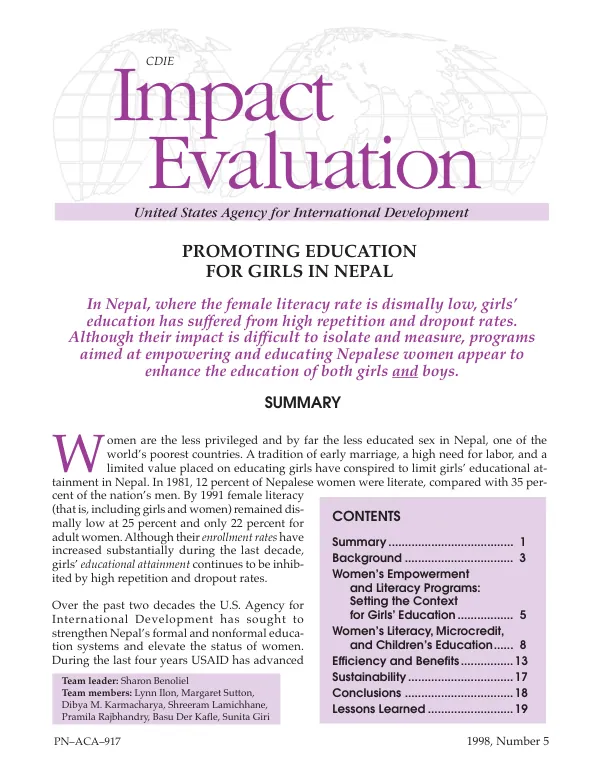
During the last 4 years, USAID has advanced efforts to empower Nepalese women through activities in basic literacy, legal literacy (legal rights for women), and economic participation (microcredit).
Benoliel, Sharon|Ilon, Lynn · 1997
Sign in to readA free account is required to download.
Abstract
This report, one of a series of country studies by USAID's Center for Development Information and Evaluation (CDIE), assesses the impact of these efforts. The study is based on structured interviews with 95 participating women and on examinations of their children's school records. Literacy and income generation programs have contributed in many ways to raising the quality of life among rural and impoverished women and their families in Nepal. In 1991, less than 22% of adult Nepalese women were literate. With USAID/Nepal's assistance, the literacy rate of adult women increased to an estimated 25% in 1995 and 28% in 1996. Most participants reported that their experiences in literacy classes led to an increased sense of self-confidence and to greater autonomy and authority within their domains. They have increased their participation in collective community activities and social issues and have begun to engage in improved health practices. Educational attainment of younger children in both the control group and the literacy group has increased by 10% over that of older children, i.e., those who turned school age prior to the program. Younger children in the microcredit and the microcredit-plus-literacy programs have registered gains of 37% and 18% respectively. The educational attainment levels of all four groups have increased over recent years. Much of the overall increase in education among children of mothers engaged in microcredit accrues to boys rather than girls. By contrast, the gender gap in the literacy group is lower, and that in the integrated literacy group is substantially lower. The lowest average daily attendance in 1996 was recorded among children of mothers engaged in microcredit activities, at 73% (microcredit) and 67% (literacy and microcredit). Repetition rates for both boys and girls in the microcredit and integrated program groups are lower than those for the region as a whole, as is average repetition among children in the literacy group. Extremely high repetition rates among control-group children contrast sharply with those of children in all treatment groups. Children of both genders in all three program groups were three to four times as likely as children in the control group to report that their mothers help them with school. For most women, attending classes or generating other income required that they work harder during non-class hours or hours when they were not generating income. This is a particular burden for women who attend literacy classes, because the classes take time away from all productive labor, whereas the productivity of microcredit activities may well substitute for productive time missed elsewhere. The opportunity cost of sending a girl to school for one year is about equal to the opportunity cost of a woman's attending a literacy class. The higher repetition rates of children whose mothers had not attended training added 34% to the cost of their schooling. For the poorest of the poor, assuming they can afford any opportunity costs of educational activities, education must be viewed as having immediate and direct effects to be worth the investment in time and energy. Thus, in comparing the benefits of two types of educational investments -- formal schooling of girls and informal training of mothers -- the relative benefits would be different, depending upon how marginal were the lives of the families involved. Lessons learned include the following: (1) Development of knowledge and skills among mothers may translate into higher levels of educational attainment among children. (2) The magnitude of program impact on children's education varies by socioeconomic context. (3) Increased earnings by mothers do not necessarily or immediately translate into more education for their daughters. (4) Maternal support for children's education stimulated by program participation translates into private and social savings.
![Close out report : SO [strategic objective] 3 (women's empowerment program)](https://covers.devme.ai/gen/5303.webp)