USAID DEC
Promoting small and medium scale manufacturing of products from the minerals and rocks of Malawi
Sign inUSAID. MISSION TO MALAWI
Promoting small and medium scale manufacturing of products from the minerals and rocks of Malawi
This study describes the full range of inventories of "industrial mineral" resources found in Malawi which can be exploited in the immediate future by small or medium-scale Malawian entrepreneurs.
Chatupa, James; Giarrizzo, Frank +1 more · 1990
Sign in to readA free account is required to download.
Abstract
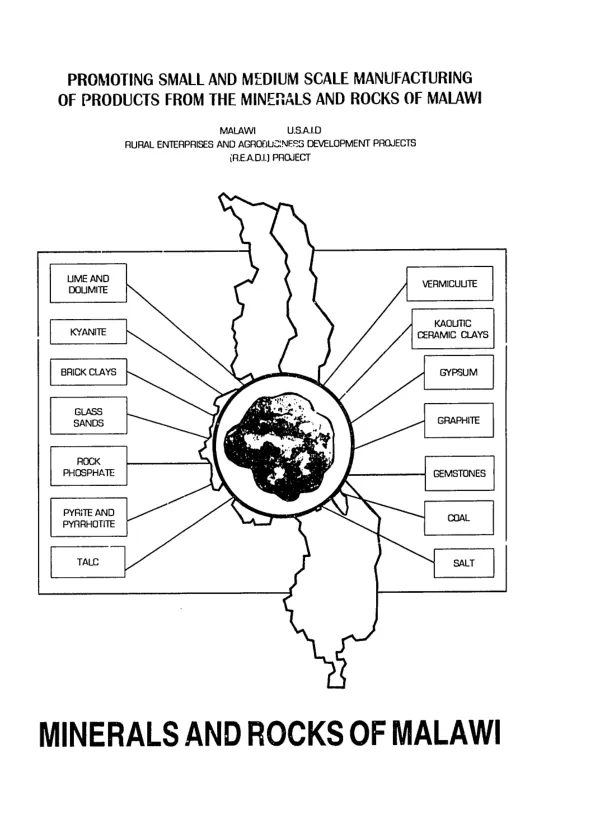
These resources include: limestone and dolomite; vermiculite; gypsum; glass sands; kaolinitic ceramic clays; graphite; gemstones and ornamental stones; salt; pyrite/pyrrhotite; talc; rock phosphates; brickclays and kyanite. Coal, although an energy resource, is included since there is potential for utilizing coal as a source of energy in the mining sector. In that way it may be possible to reduce the current high level of deforestation in Malawi. All mining in Malawi, whether small-scale or capital intensive, is regulated by law. Malawi laws and regulations are sympathetic to the promotion of small enterprises and provisions have been made to tolerate most mining as long as environmentally sound practices are used. Malawi currently imports over K15 million of raw materials and products made from most of the mineral resources listed above. Therefore, there is great potential for promoting import substitution enterprises in the mining sector. The most promising ventures would be in locally mining, processing, and producing finished commodities from the following mineral resources: (1) high potential for exploitation -- limestone and dolomite; kaolinitic ceramic clays and glass sands; brickclays; gypsum; rock phosphates; (2) medium to low potential for exploitation -- vermiculite; graphite and talc; pyrite/pyrrhotite; salt; and kyanite. There is a steady demand for vermiculite, graphite, and to some extent kyanite on the world market. Vermiculite has the highest potential for success on the competitive world market, followed by "flake graphite." Hence, exploitation of these resources could be promoted in terms of a capital intensive operation, or several small scale enterprises. Gemstones are best mined by small scale miners but marketing of gemstones requires use of sophisticated marketing techniques. Malawi based marketing agencies urgently need to be created. Both vermiculite and graphite occur as small discrete bodies, but in substantial aggregate reserves. Exploitation of such resources could lend itself to separate small-scale operations under the umbrella of some form of cooperative organization. There is a great need to develop mineral resources for the agricultural sector where there is a great potential for increased demand. In the category of agro-minerals the important minerals are limestone and dolomite, gypsum, rock phosphates, talc, pyrite and pyrrhotite, and the kaolinitic clays. This is a new product area which will require aggressive market promotion. Most of the industrial minerals resources are located in fairly accessible areas. There are also adequate land and water supplies to start small to medium scale enterprises. The main constraints will be in the following areas. (1) Most industrial minerals resources have low in-situ value, hence it may not be economically feasible to transport them over long distances. Consequently, projects may only be viable if the materials can be processed or marketed close to the deposit site. Only resources with high value added are really worth transporting over great distances, to the market place. (2) The availability of electricity close to a deposit would be the most favorable factor in the viability of a prospect. Where electricity is not available there would be a lower potential for development of a viable new enterprise. (Author abstract)
Related documents