USAID DEC
Promoting trade and investment in constrained environments : A.I.D. experience in Latin America and the Caribbean
Sign inUSAID. BUR. FOR PROGRAM AND POLICY COORDINATION. CENTER FOR DEVELOPMENT INFORMATION AND EVALUATION (CDIE)
Promoting trade and investment in constrained environments : A.I.D. experience in Latin America and the Caribbean
Since 1974, A.I.D.
1990
Sign in to readA free account is required to download.
Abstract
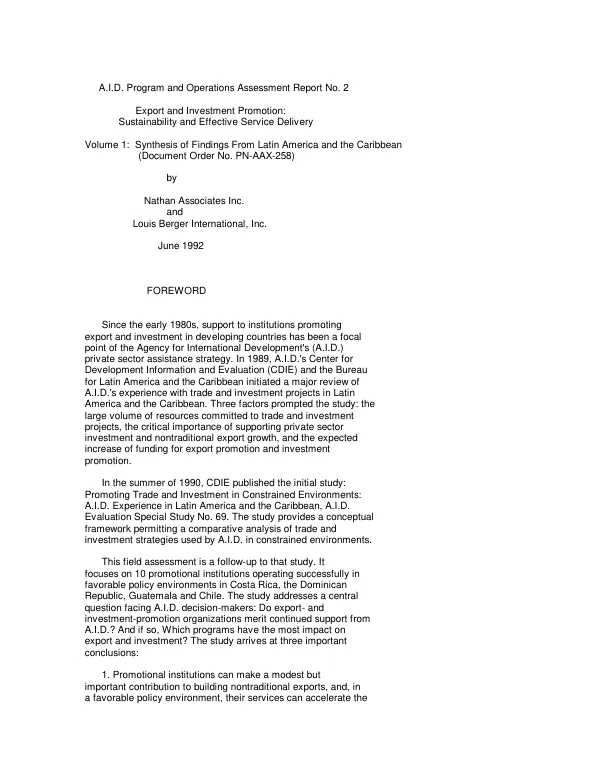
has disbursed more than $675 million for more than 120 trade and investment projects. The majority of these funds were spent in Latin America and the Caribbean, where country experiences with foreign trade are widely diverse. While A.I.D. projects in strong exporting countries have often been successful, there is some doubt as to their impact in constrained economic environments. This report reviews 15 projects, with emphasis on the following variables: the country"s productive structure; the policy environment; the export capability of the target group; host country support; project delivery mechanisms (public sector, private sector, or mixed); A.I.D. management effectiveness; and level of risk. The report also classifies the 15 projects according to three generic types: the transmitter approach, which relies mostly on developing and transmitting market information by maintaining data bases and answering investor/exporter queries; the facilitator approach, which provides multisectoral, general investment and export promotion services; and the promoter approach, which offers enterprise- specific technical assistance and brokering services to a limited number of producers in a limited number of sectors. The report concludes that the promoter approach seems best suited to the weak productive structure and volatile policy environments within which A.I.D. projects typically operate. The three major strengths of the promoter approach are its high degree of targeting, its focus on demonstrating project impacts early on, and its flexibility in allowing project managers to change the objectives, scope, and level of funding of a project in response to market forces.