USAID DEC
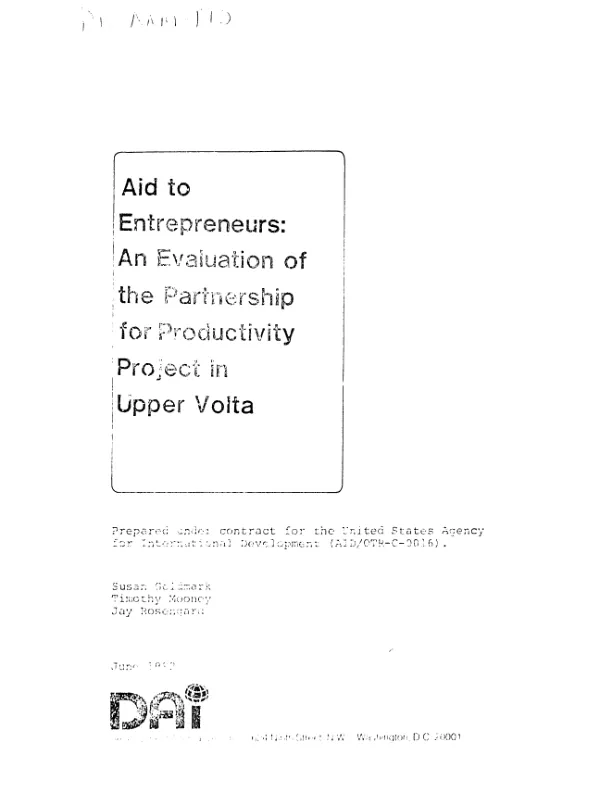
Promoting urban entrepreneurs : an evaluation of the Peruvian Urban Development Fund
Sign inDEVELOPMENT ALTERNATIVES, INC. (DAI)
Promoting urban entrepreneurs : an evaluation of the Peruvian Urban Development Fund
Evaluates project to establish an Urban Development Fund (UDF) within the Industrial Bank of Peru (BIP) to provide loans and TA to small businesses in urban slums.
Goldmark, Susan; Deschamps, Jean-Jacques +1 more · 1985
Sign in to readA free account is required to download.
Abstract
Special evaluation covers the period 1982-4/85 and is based on document review and client surveys and interviews. The UDF has provided credit and TA to small urban enterprises that previously had no access to these services and in so doing has generated substantial economic growth and new employment in urban slums while creating a strong base within the BIP for future small business lending. Under both maximum and minimum case assumptions, the project has a high cost-benefit ratio. A survey of 84 firms indicates that the average industrial borrower created 2 new jobs at an average loan cost of $2,000 (vs. a cost of $36,500 to create a job in Peru"s modern industrial sector); service borrowers created 1.3 jobs per loan (at $4,500 cost), and commercial firms only 0.4 jobs (at $7,800). Borrowers" net worth increased at an average yearly compounded rate of 34% and sales at a 38% rate. However, despite impressive gains by some firms, ratio of profitability to sales declined sharply for service firms and somewhat for industrial firms since loan receipt. Fifty BIP training courses were provided to 1,250 existing or potential UDF sub-borrowers in 1984. The project has also enabled BIP to offer savings programs in slum areas. The most serious problem is that rapid decapitalization of the UDF is occurring due to negative effective interest rates. BIP has not made any contributions to compensate for losses in fund value nor is it in a position to do so in the near future. Also, although 75% of borrowers are able to make interest payments, 54% have high or unacceptable debt repayment burdens. Although BIP management of the UDF has been good overall, staff training has been practically nil. Loan processing is often inefficient, certain branches have a poor collection record, and internal analysis and monitoring are inadequate. During the first year, lending was far below target and was concentrated heavily in the Lima area; these faults have been corrected. Recommendations include a waiver of BIP"s obligation to recapitalize the UDF on a yearly basis, balanced by an increase in interest rates and improved efficiency in loan processing, disbursement, and collection.
Related documents