WILDLIFE CONSERVATION SOCIETY (WCS) (NEW YORK, NY)
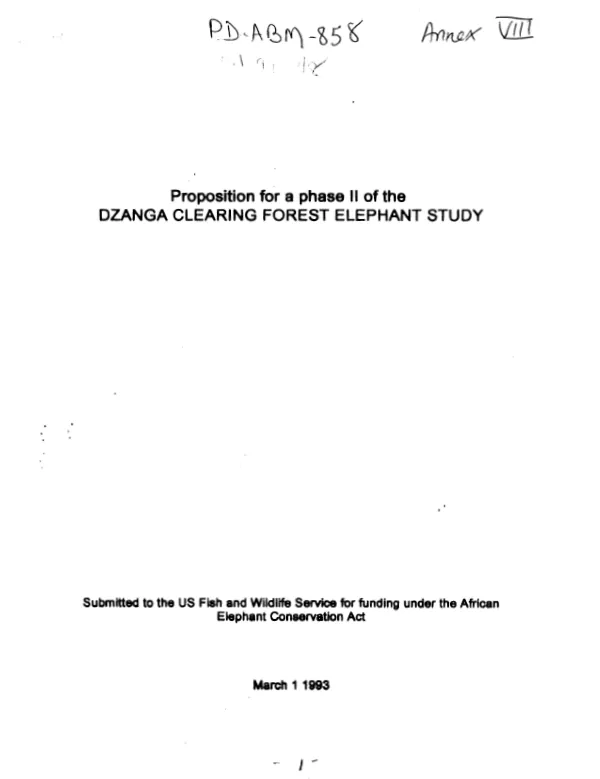
Proposition for a phase II of the Dzanga clearing forest elephant study
A study of forest elephants has been ongoing in the Dzanga clearing of the Dzanga-Sangha Reserve in the Central African Republic since 1990, with data being collected on the size, demographics, morphometrics, genetics, social structure, social behavior, and ecology of a single forest elephant population.
1993
Sign in to readA free account is required to download.
Abstract
The study, according to this proposal for Phase II funding, has two major implications for elephant conservation. (1) The Dzanga elephant population, which is the same as that which ranges in the Nouabale-Ndoki Forest of Congo, is one of the largest free ranging populations left in Africa. Precise population and ecological data are needed for management of this population. The data being collected at the Dzanga clearing are going well beyond anything that has been previously been done on African elephants, except for studies on the Amboseli population. These data are invaluable for herd management. (2) The constant monitoring of the Dzanga herd and presence of a permanently manned research station in the very sensitive area around the Dzanga clearing may be the best viewing place in all of Africa for elephants and is the focal point and raison d"etre of the entire Dzanga Sangha Reserve. Its protection and constant monitoring are an integral part of the protection of the Dzanga-Sangha herd because it is where elephants are most vulnerable. (Author abstract, modified)
Connected topics
Related documents
Documents in this collection
 2006
2006USAID DEC
Glover"s Reef living seascape : safeguarding marine resources and rural livelihoods in Belize -- implementation plan, October 2006-September 2007
Open record 2006
2006USAID DEC