USAID DEC
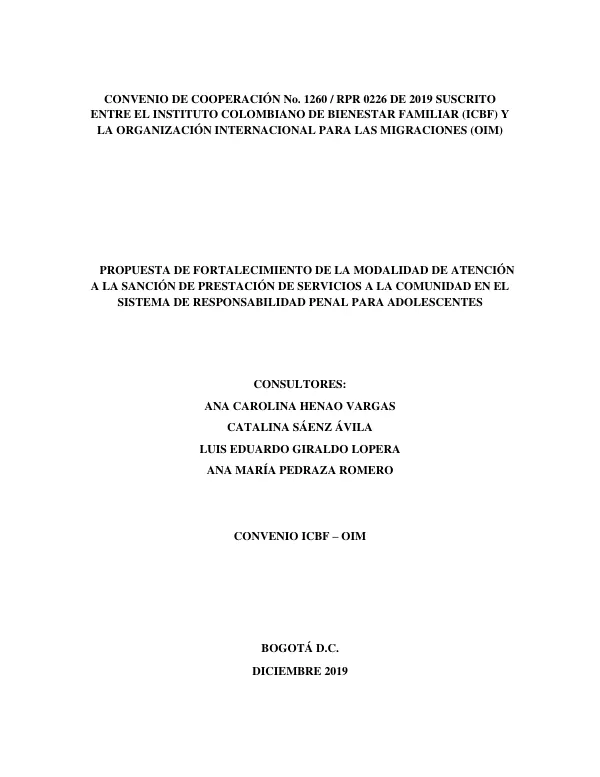
Propuesta de Fortalecimiento de la Modalidad de Prestación de Servicios a la Comunidad en el Sistema de Responsabilidad Penal para Adolescentes
Sign inINSTITUTO COLOMBIANO PARA EL BIENESTAR FAMILIAR
Propuesta de Fortalecimiento de la Modalidad de Prestación de Servicios a la Comunidad en el Sistema de Responsabilidad Penal para Adolescentes
The Colombian Institute of Family Welfare (ICBF) and the International Organization for Migration (OIM) signed a cooperation agreement, Convenio de Cooperación No.
2019 · 66 pages
Sign in to readA free account is required to download.
Abstract
1260 / RPR 0226 DE 2019, in 2019. This agreement aimed to strengthen the modality of attention to the sanction of provision of services to the community in the System of Penal Responsibility for Adolescents (SRPA). The proposal for strengthening the modality of provision of services to the community in the SRPA was developed by consultants Ana Carolina Henao Vargas, Catalina Sáenz Ávila, Luis Eduardo Giraldo Lopera, and Ana María Pedraza Romero. The proposal was structured in two chapters: the first chapter focused on obtaining results in a structural scenario, and the second chapter addressed operational results. In the structural scenario, the proposal aimed to strengthen the articulation between the ICBF, the Supreme Court of Justice, the Attorney General's Office, and the Ombudsman's Office. The goal was to enhance the understanding of adolescents regarding the sanction, recognize the modality of Provision of Services to the Community (PSC) as a measure with high social impact, and involve direct and indirect victims in restorative processes. The operational results chapter outlined actions to be taken by the ICBF and pedagogical operators to strengthen the SRPA. These actions aimed to have positive effects on the attention processes for adolescents and young people and to reflect in community contexts in a binding way with other strategic actors for the SRPA. The proposal aimed to contribute to the improvement of the attention modality and the effective fulfillment of the SRPA's objectives. Some of the proposals were identified and extracted from positive actions and experiences in the fieldwork, while others were created in accordance with the identified problems. The proposal emphasized the importance of socializing the diagnoses and proposals with the pedagogical operators and other actors involved in the SRPA. This would allow evaluating the positions of agreement and disagreement, visualizing the possible impacts of the implementation of the proposal, and anchoring the proposed activities with existing spaces. The proposal also highlighted the need for effective participation of all SRPA actors in addressing the factors or situations that have generated tensions and recognizing and retroalimentating collective practices and lessons learned, mainly among pedagogical operators. The proposal's implementation aimed to create scenarios of encounter, dialogue, and recognition that would allow the different actors to constructively address the elements that generate tensions or dialogue of knowledge and experiences that would potentiate the collective and binding construction of alternatives that would potentiate the expected effects from the SRPA for adolescents and young people at the individual, family, and community levels. The proposal's implementation would require vigilance of the impacts that could be generated, both in the relationships and daily dynamics of SRPA actors and in the context in which the modality operates. The proposal's approach was based on the concept of Action Without Harm, which recognized that any intervention in a specific context would have a positive impact in the sense that it would facilitate the strengthening of synergies between actors or a negative impact in the sense that it would generate conflicts or complicate the processes being developed. The proposal's implementation would be a horizontal process in which all actors would participate actively, retroalimentating the information circulated by the ICBF and constructing strategies. The proposal's implementation would also require the recognition and retroalimentation of collective practices and lessons learned, mainly among pedagogical operators.
Related documents