UNIVERSITY RESEARCH CORP. (URC) CENTER FOR HUMAN SERVICES
Punjab task allocation study
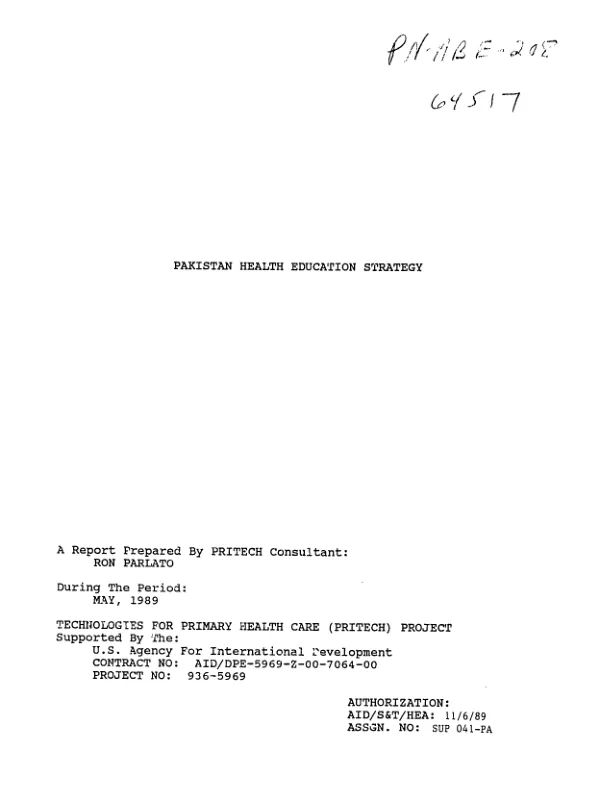
The delivery of three child survival interventions in Punjab State, Pakistan - malaria treatment, diarrhea management, and vaccinations - was studied as a means of determining the use of the State"s primary health care facilities - basic health units (BHU"s) and rural health centers (RHC"s) - and the effectiveness of community-level multi-purpose health workers (MPHW"s).
Nicholas, David D. · 1989
Sign in to readA free account is required to download.
Abstract
This report summarizes the methodology of the study, its major findings, and the proceedings of two workshops held to discuss study results, and uses 48 figures as the principal medium for presenting the research findings, the most important of which were as follows. (1) Half of the surveyed population use a government facility, predominantly a BHU, and are generally satisfied with the service received there. Many of the reasons given for not using BHU"s (e.g., staff absenteeism) could be addressed with current resources. (2) Villagers are fairly well informed on the purpose and availability of vaccinations and the preparation of oral rehydration solution, but not on malaria management. Malaria treatment was also the weakest of the three areas studied, while diarrhea management and vaccinations were generally well handled. (3) Nearly 80% of the respondents were visited by a MPHW at one time, almost half of them during the past month. Except for malaria, the input of field supervisors had little impact on MPHW performance. The study concluded that the single factor explaining the relative popularity of some BHU"s over others is the quality of services provided by MPHW"s working in the immediate area. Facility utilization may, therefore, be increased through better management and closer supervision of outreach personnel.