USAID DEC
PYROLYTIC CONVERSION OF AGRICULTURAL AND FORESTRY WASTES TO ALTERNATE ENERGY SOURCES IN INDONESIA; A FEASIBILITY STUDY
Sign inGEORGIA INSTITUTE OF TECHNOLOGY. SCHOOL OF INDUSTRIAL AND SYSTEMS ENGINEERING. ENGINEERING EXPERIMENT STATION
PYROLYTIC CONVERSION OF AGRICULTURAL AND FORESTRY WASTES TO ALTERNATE ENERGY SOURCES IN INDONESIA; A FEASIBILITY STUDY
Presents the results of a short feasibility study of the application to pyrolytic conversion techniques to agricultural and forestry wastes in Indonesia.
TATOM, JOHN W.; HARAHAP, FILINO · 1970
Sign in to readA free account is required to download.
Abstract
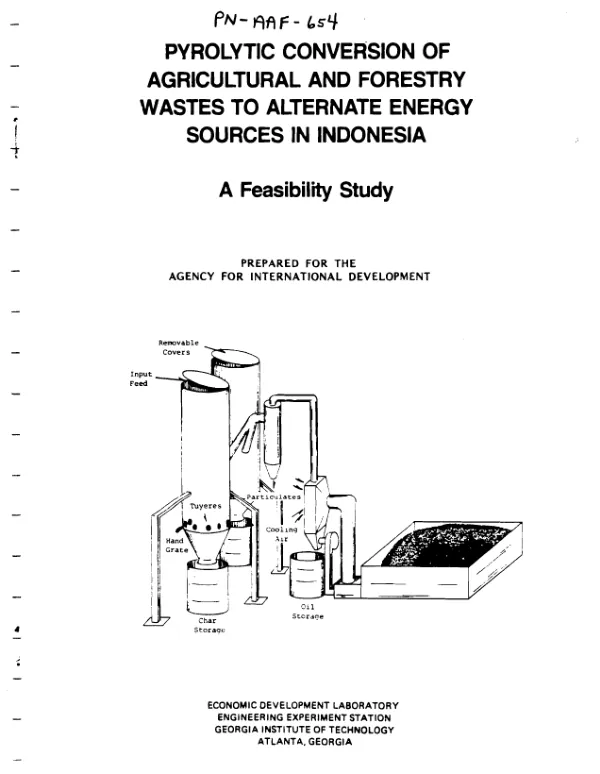
The principal circumstance that led to the study is the severe firewood cutting of the forests, especially in Java, which has resulted in damage to soil, water, and mangrove resources, with the resulting need for an alternate source of fuel for cooking. Agricultural and forestry wastes appears as a possible fuel source, but in their initial form are largely unusable for the purpose. Through the use of pyrolysis these wastes can be converted into clean-burning char and oil, which can be easily stored and transported, and a gas which can be used on site. The study involved: an investigation of the production of agricultural and forestry wastes in Indonesia; an evaluation of the market for the char, oil, and gas which are products of the pyrolytic conversion process; the development of a preliminary pyrolytic conversion system design; and an approximate economic evaluation of the system. Seventeen million tons of wastes are produced in Indonesia each year, with rice hulls comprising a third of the total and sawmill, coconut, logging, rubber, oil palm wastes, and bagasse comprising the remainder. It is estimated that about 1.5 million tons of charcoal and .9 million tons of pyrolytic oils could be produced. This represents something like 15% of the total 1974 Indonesian energy consumption. The preliminary design study has produced three different appropriate technology one-ton-per-day systems using rice hulls as the fuel and for use at typical rice mills. The need for a follow-up demonstration program is discussed and a program plan devised.