CENTERS FOR DISEASE CONTROL (CDC) (U.S.)
Quantitative determination of feeding rates of anopheles albimanus larvae
Much of the food of mosquito larvae consists of particulate matter which they extract from the water by a filter-feeding mechanism.
Wilton, D. P.; Fetzer, L. E. +1 more · 1970
Sign in to readA free account is required to download.
Abstract
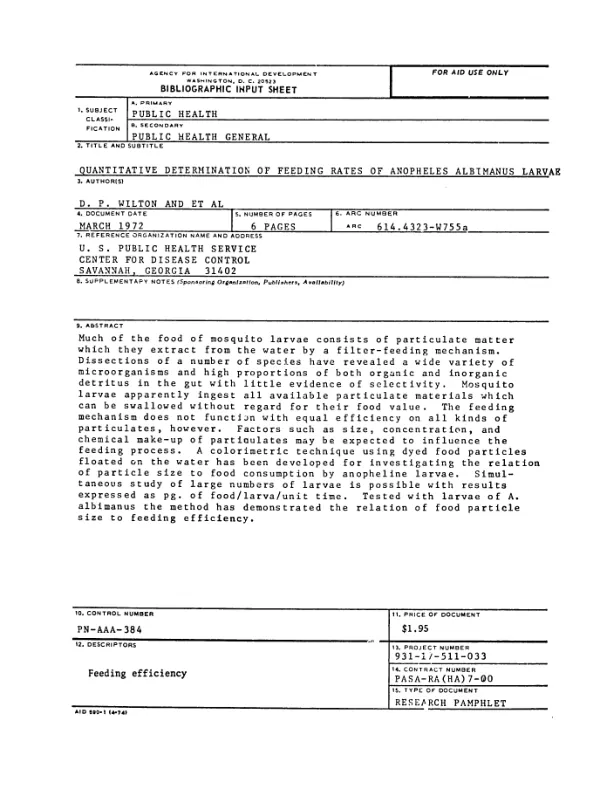
Dissections of a number of species have revealed a wide variety of microorganisms and high proportions of both organic and inorganic detritus in the gut with little evidence of selectivity. Mosquito larvae apparently ingest all available particulate materials which can be swallowed without regard for their food value. The feeding mechanism does not function with equal efficiency on all kinds of particulates, however. Factors such as size, concentration, and chemical make-up of particulates may be expected to influence the feeding process. A colorimetric technique using dyed food particles floated on the water has been developed for investigating the relation of particle size to food consumption by anopheline larvae. Simultaneous study of large numbers of larvae is possible with results expressed as pg. of food/larva/unit time. Tested with larvae of A. albimanus the method has demonstrated the relation of food particle size to feeding efficiency.
Connected topics