USAID DEC
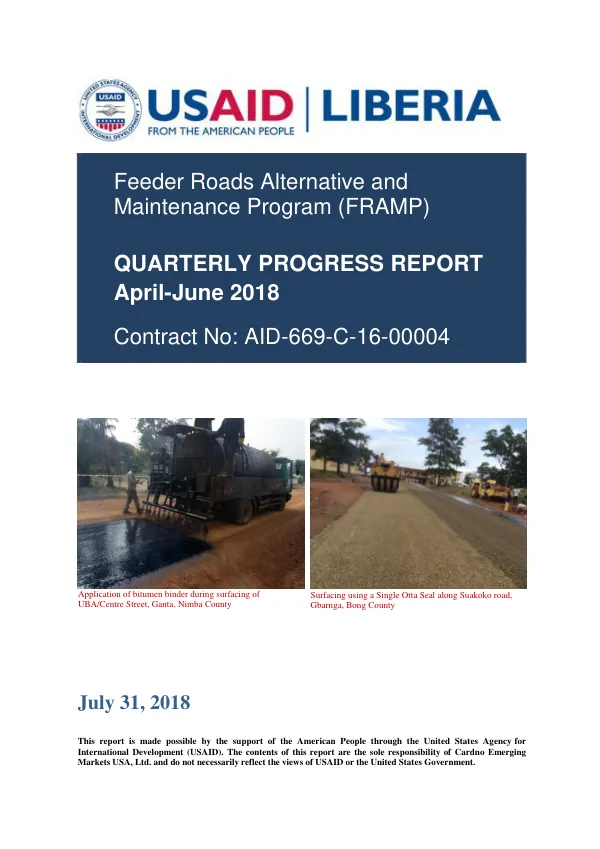
Quarterly Progress Report: Feeder Roads Alternative and Maintenance Program (FRAMP) April-June 2018
Sign inCARDNO EMERGING MARKETS USA, LTD.
Quarterly Progress Report: Feeder Roads Alternative and Maintenance Program (FRAMP) April-June 2018
The Feeder Roads Alternative and Maintenance Program (FRAMP) is a USAID-funded initiative aimed at supporting the Government of Liberia in constructing, operationalizing, and implementing sustainable routine maintenance systems for feeder roads.
2018 · 30 pages
Sign in to readA free account is required to download.
Abstract
The program also involves piloting alternative low volume sealed road construction techniques through research and development interventions. FRAMP is being implemented through a contract with Cardno Emerging Markets, Ltd, along with Sheladia Associates, Inc. FRAMP has four main objectives: to develop and operationalize sustainable feeder road maintenance systems through county-level systems under national technical and managerial oversight; to provide construction oversight for a total of 409 km of rehabilitation of farm-to-market roads and emergency repairs of highways; to pilot routine maintenance activities on selected roads in the target counties through maintenance systems developed under Objective 1; and to construct alternative low volume road seals on 94,390 m2 of selected roads in the target counties. During the period under review, the FRAMP team in the field continued to monitor the on-going road rehabilitation contracts, with a focus on ensuring that the works are progressing according to the agreed timelines and specifications. The team also conducted regular site visits to assess the quality of work and provide technical support to the contractors as needed. In terms of specific activities, the FRAMP team developed and implemented a monitoring, evaluation, and learning plan (MELP) to track progress against the project's objectives and indicators. The team also conducted a road inventory and condition survey to identify areas that require routine maintenance and repair. Additionally, the FRAMP team established a materials testing laboratory on a cost recovery basis to ensure that the materials used in the road construction and maintenance activities meet the required standards. The FRAMP team also worked closely with the Ministry of Public Works (MPW) and the counties to strengthen their capacity to manage road maintenance and construction activities. This included providing training and technical assistance to the MPW and county officials on road maintenance and construction techniques, as well as supporting the development of a road maintenance strategy and implementation plan (RMSIP). In terms of construction oversight, the FRAMP team provided support to USAID in contractor selection and management of road contracts, with a focus on ensuring that the contractors are meeting the required standards and specifications. The team also conducted regular site visits to assess the quality of work and provide technical support to the contractors as needed. The FRAMP team also worked on piloting routine maintenance activities on selected roads in the target counties, with a focus on identifying best practices and lessons learned that can be applied to the wider road maintenance program. This included conducting community-based organization routine maintenance of feeder roads, as well as recurrent and periodic maintenance of selected feeder roads. In terms of alternative low volume road seals, the FRAMP team conducted a demonstration/trial road to test the feasibility and effectiveness of this technology. The team also sealed Gbarnga streets and Ganta streets, with a total of 94,390 m2 of road surface treated. Overall, the FRAMP team made significant progress during the period under review, with a focus on implementing the project's objectives and activities in a timely and effective manner. The team worked closely with the MPW, counties, and other stakeholders to ensure that the project's outcomes are achieved and that the benefits of the project are shared equitably among all stakeholders.
Related documents