USAID DEC
Quarterly Report, April 1 – June 30, 2013: Kenya Transition Initiative (KTI) - Eastleigh
Sign inUSAID
Quarterly Report, April 1 – June 30, 2013: Kenya Transition Initiative (KTI) - Eastleigh
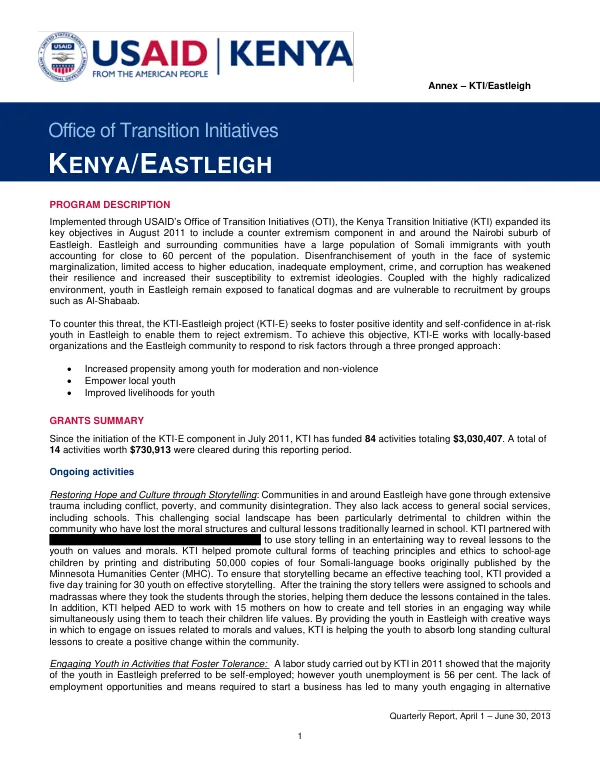
The Kenya Transition Initiative (KTI) expanded its objectives in August 2011 to include a counter extremism component in and around the Nairobi suburb of Eastleigh.
2013 · 5 pages
Sign in to readA free account is required to download.
Abstract
Eastleigh and surrounding communities have a large population of Somali immigrants, with youth accounting for close to 60 percent of the population. Disenfranchisement of youth in the face of systemic marginalization, limited access to higher education, inadequate employment, crime, and corruption has weakened their resilience and increased their susceptibility to extremist ideologies. To counter this threat, the KTI-Eastleigh project (KTI-E) seeks to foster positive identity and self-confidence in at-risk youth in Eastleigh to enable them to reject extremism. To achieve this objective, KTI-E works with locally-based organizations and the Eastleigh community to respond to risk factors through a three-pronged approach: increased propensity among youth for moderation and non-violence, empowerment of local youth, and improved livelihoods for youth. Since the initiation of the KTI-E component in July 2011, KTI has funded 84 activities totaling $3,030,407. A total of 14 activities worth $730,913 were cleared during the reporting period. Ongoing activities include Restoring Hope and Culture through Storytelling, which aims to use storytelling in an entertaining way to reveal lessons to youth on values and morals. KTI partnered with An-Nissa for Education and Development (AED) to print and distribute 50,000 copies of four Somali-language books, and provided a five-day training for 30 youth on effective storytelling. Another ongoing activity is Engaging Youth in Activities that Foster Tolerance, which aims to provide a space where youth can engage in legal recreational activities while steering them away from gang recruitment. KTI partnered with Berlin Self Help Group (BSHG) to renovate a soccer pitch and organize a soccer tournament, and provided BSHG with training on project management and tolerance. The ten-day training also engaged 25 youth BSHG members. Supporting the Kamukunji Youth Network is another ongoing activity, which aims to support and capacity-build the organization to enable it to be self-sustaining in carrying out its mandated activities. KTI is currently supporting the network by providing technical assistance for four months, and helping to set up and run its own website. The KTI-E team has established structures for data collection and aggregation, and has revised indicators in previous Eastleigh grants to match the updated Partner Performance Management Plan (PPMP). The team has also begun to digitize participants' lists in an effort to ensure program beneficiaries are documented in a database that KTI-E can easily use to pass on mass messages and evaluate the effectiveness of its outreach. The outcome indicators are reported on an annual basis, and the next steps include a rolling assessment in August 2013 and an annual survey to be conducted in September 2013. The consolidated list of output indicators for the April-June quarter includes indicators such as the number of initiatives where significant input is provided to the Government of Kenya (GoK) on youth issues, the number of youth who engage with GoK entities to effect change, and the number of youth accessing KTI-E-supported media outlets advocating moderation and non-violence.