USAID DEC
Quarterly Report for Cooperative Agreement AID-523A-16-0001
YouthBuild International significantly expanded the capacity of the Jóvenes con Rumbo (JcR) program to serve at-risk youth in local communities during the past quarter.
2016 · 47 pages
Sign in to readA free account is required to download.
Abstract
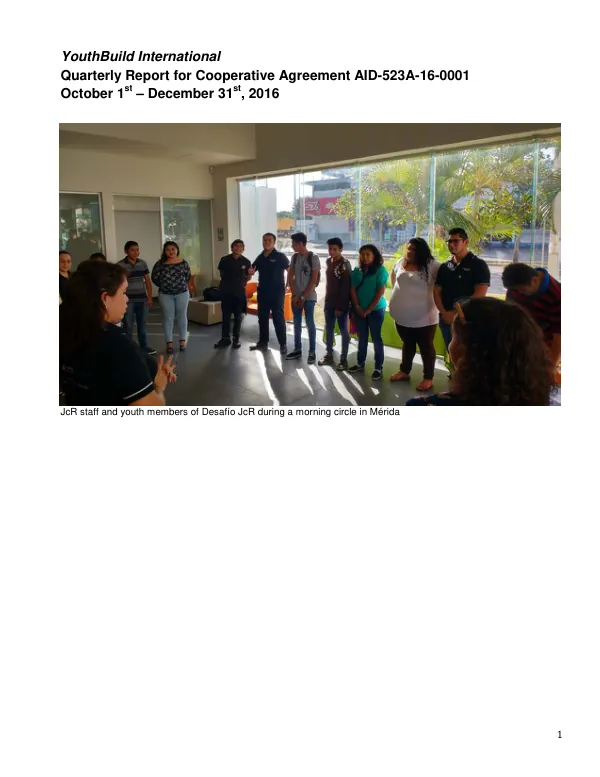
The program achieved its target goal to establish and open three new youth centers to replicate the program. In response to the implementation of new laws affecting Mexican youth, the New Accusatory Criminal Justice System in Mexico and the new National Law of the Integral Criminal Justice System for Adolescents, staff adapted the JcR tertiary prevention model to expand and enhance programming for youth in conflict with the law and for youth serving non-custodial sentences. The JcR program proposed a series of innovations to create a longer, more intensive program that could strengthen the programming and support for participants and achieve a longer-lasting impact. The resulting Desafío JcR pilot program was launched on November 7 with a group of 97 youth in four sites: Monterrey, Tijuana, Ecatepec, and Mérida. Some of the main innovations of this program include a two-week motivation/preparation phase, the definition of the program's values and core competencies, and the incorporation of a job internship before the end of the program. JcR met its target goal by opening a youth center in El Pípila, in Tijuana, and in San Bernabé in Monterrey, bringing the total number of youth centers to eleven. Four of these centers are being sustained entirely with funding from newly leveraged resources from Nacional Monte de Piedad and Boeing. The Center for Education and Social Studies (CEES) initiated the implementation of questionnaires for JcR members and at-risk youth from similar communities as part of the external impact evaluation. CEES also initiated the process evaluation and delivered its first preliminary report. JcR adapted its Social Reinsertion Model to serve more youth in conflict with the law following changes in the criminal justice law for adolescents. In October, JcR held a two-day workshop with program staff and experts in the law to begin the adaptation process. The program's main achievements during the period include the launch of the Desafío Jóvenes con Rumbo program, the opening of two new Youth Centers, the launch of the implementation of baseline studies for the external impact evaluation, and the adaptation of the Social Reinsertion Model for youth in conflict with the law. The JcR program's expansion and adaptation efforts demonstrate its commitment to serving at-risk youth in local communities and addressing the changing needs of the population. The program's innovations and adaptations aim to strengthen the programming and support for participants and achieve a longer-lasting impact. The external impact evaluation and process evaluation will provide valuable insights into the program's effectiveness and inform future improvements.
Related documents