FHI 360
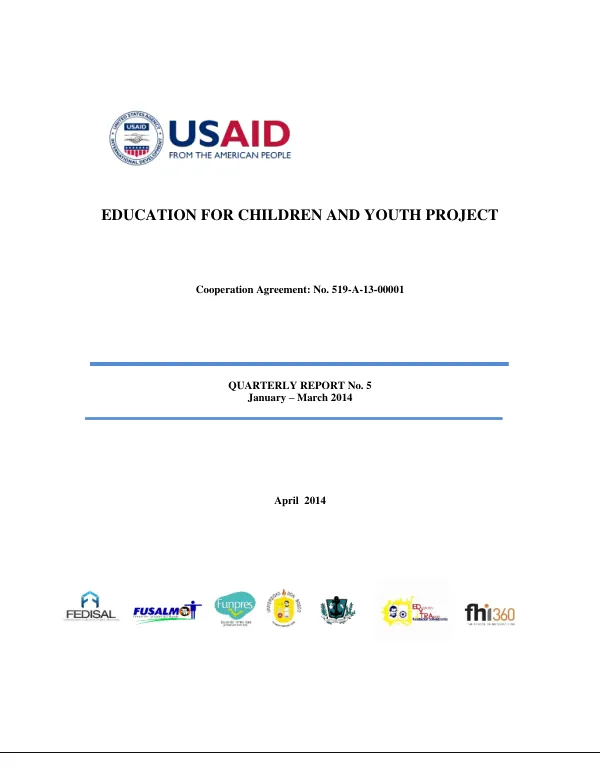
Quarterly Report No. 5: Education for Children and Youth Project
The Education for Children and Youth Project is implemented as part of the Partnership for Growth initiative and the Global Education Strategy of the United States Agency for International Development (USAID) in El Salvador.
2014 · 44 pages
Sign in to readA free account is required to download.
Abstract
The project aims to support the Ministry of Education (MoE) in its efforts to extend access to education for children and youth who live in areas with high rates of violence and delinquency in El Salvador. The project's main objective is to improve the quality of education through the practice of inclusive, pertinent, and safe learning environments. The project was initiated on January 2nd, 2013, and will finalize in December 2018. It will be implemented in 25 municipalities, which have the highest indexes of violence. The government partner is the Ministry of Education (MoE), and USAID has signed an agreement with the Foundation for Integral Salvadorian Education (FEDISAL) as the local partner. FEDISAL has a partnership network that includes six organizations: Salvador del Mundo Foundation (FUSALMO), Salesian Association Institution (AIS), Education and Work Foundation (EDYTRA), Don Bosco University (UDB), Pro-Education Foundation of El Salvador (FUNPRES), and an international partner, Family Health International (FHI 360). The project has made substantial advances in the two key components and activities for the project's progress. In Objective 1, the project has promoted and supported the implementation of the national educational policy within the Full Time Inclusive School Approach (FTIS) at a national level. The project has supported USAID at the MoE's donor table at a national level and promoted the implementation of the national educational policy within FTIS. The project has also analyzed national interest topics with MoE, such as education investment and funding for the expansion of FTIS, its impact, and sustainability. In Objective 2, the project has provided educational opportunities to youth who are not part of the national education system. The project has supported the FTIS expansion strategy and improved the educational quality of lower secondary in 165 schools in 8 municipalities with a high violence risk. The project has supported the socialization of the educational strategy for the preparation of the pedagogic proposal of the Integrated Systems and schools. The project has also supported the FTIS expansion in 165 schools and 60 integrated systems in 8 high-risk municipalities. The project has also made progress in the technical assistance strategy, which has initiated at a Departmental Directorship, Pedagogic Technical Assistance level in 8 departments. This will ensure sustainability and maintain accomplished achievements in schools. The project has also trained 27 "pioneer" teachers in Mathematics and 6 pedagogic technical assistants in the use of learning guides in lower secondary by using the model I Learn, I Practice, and I Apply (LPA) for content structure. An 80% of the "pioneer" teachers who use active methodologies are now applying guides that use the LPA model in lower secondary Mathematics.