ABT ASSOCIATES
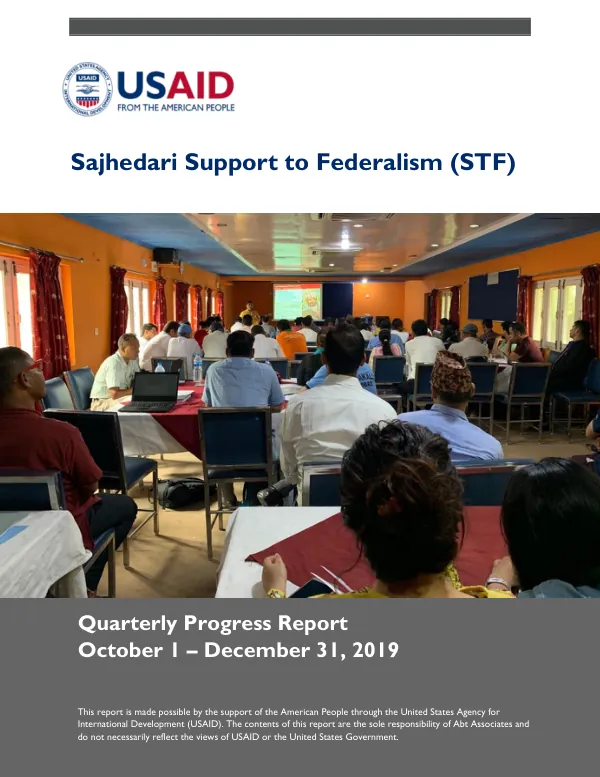
Quarterly Report: Sajhedari – Support to Federalism
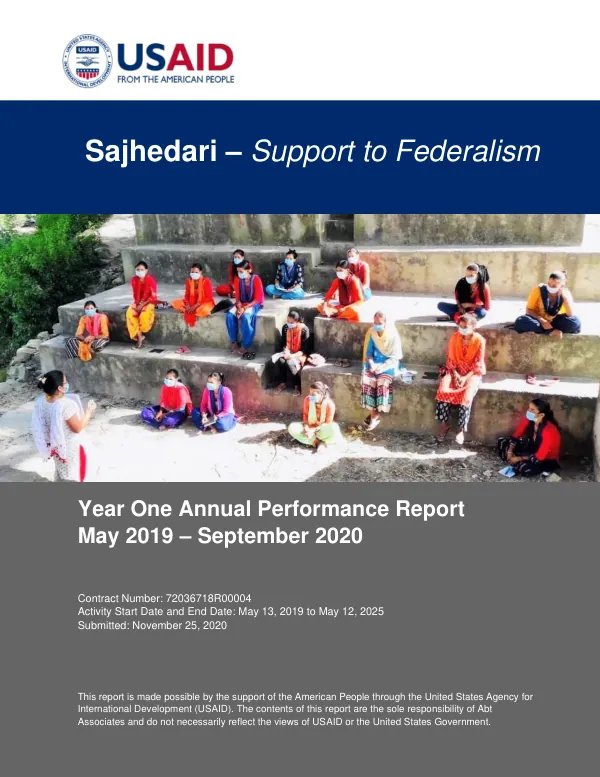
The Sajhedari – Support to Federalism project in Nepal began in May 2019 with funding from the United States Agency for International Development (USAID).
2021 · 50 pages
Sign in to readA free account is required to download.
Abstract
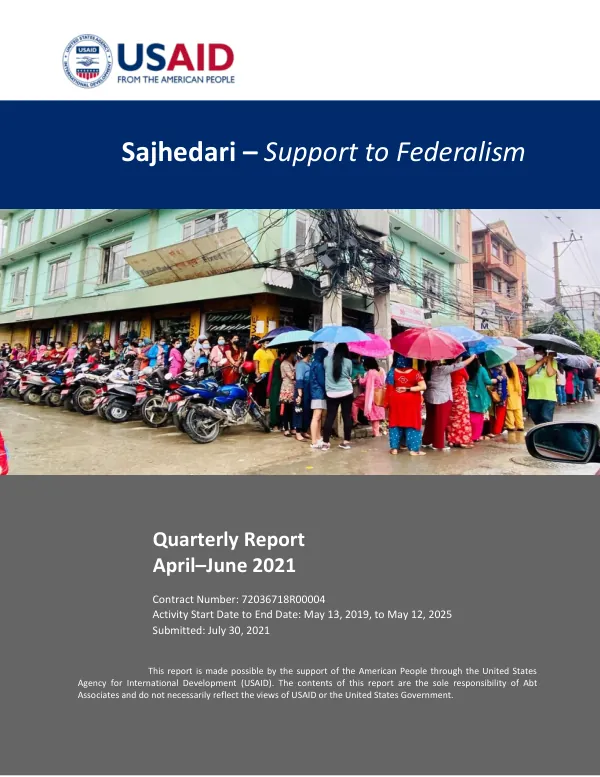
The project aims to support Nepal in its post-conflict constitutional transition from a unitary to a federalist state. Specifically, Sajhedari provides technical assistance to the Government of Nepal (GoN) in transitioning from a unitary state to a federation of provinces with more effective, accountable, responsive, and inclusive local governance. The project focuses on 10 palikas across Nepal's Sudurpaschim and Lumbini provinces, supporting USAID's Development Objective #1: "More Inclusive and Effective Governance." Sajhedari pursues this goal through three objectives: (1) the GoN creates and implements sound policies and legislation informed by evidence and that empower, finance, and regulate provincial and municipal governments; (2) the targeted provinces and selected municipal governments are more responsive, inclusive, accountable, transparent, and effective in decision-making and delivering priority services to fulfill core legal responsibilities; and (3) citizens and civil society organizations (CSOs) in targeted geographic areas, including the historically marginalized, actively participate in local decision-making and oversight. The project's quarterly progress report for April-June 2021 covers the period from April 1, 2021, through June 31, 2021. The report begins with an update on Nepal's political situation, which has been dominated by fallout from Prime Minister Oli's December 2020 dismissal of the House of Representatives (HoR). The Supreme Court reversed Prime Minister Oli's move, reinstating the HoR, and annulled the merger that had formed the dominant Nepal Communist Party (NCP). Political leaders spent much of the last three months competing for power, creating political contestation, polarization, and uncertainty. Despite the confusion and uncertainty, the GoN completed the annual budgeting process through an ordinance, and all of Sajhedari's partner palikas appeared poised to present their annual budgets and plans to their municipal assemblies in July. In parallel to the political deadlock, Nepal underwent another series of lockdowns due to the resurgence of COVID-19 in April 2021. The country saw a slow drawdown in lockdown restrictions, despite uncertainty about public health risks; changing patterns of COVID-19 cases and response efforts; and a record-breaking spike in cases and deaths that triggered an even stricter nationwide lockdown. The project's progress under each of the three main objectives is discussed in the report, as well as in cross-cutting areas such as gender equality and social inclusion (GESI) and monitoring, evaluation, and learning (MEL). The report also discusses operations and project management, grant implementation and appraisal, including consultants and subcontracts. The report concludes by flagging problems encountered this quarter and proposing remedial actions, and highlighting major upcoming events planned for next quarter. The project's partner provinces, Lumbini and Sudurpaschim, are affected by the ongoing political contestation. In Lumbini, the opposition parties have filed a petition against the Chief Minister's reappointment, while in Sudurpaschim, three cabinet ministers are under fire from their own party for not resigning. Sajhedari's working municipalities are also affected, given their party affiliation, but are awaiting the Court's verdict before making a final move. The ongoing political contestation was further complicated on June 22, when the Supreme Court instructed Prime Minister Oli's government to sack most of his cabinet. The Prime Minister has now reshuffled his cabinet twice since the HoR's dissolution on May 22. The new cabinet is largely composed of members from a faction of a Madhesh-based party, and now includes only four ministers and Prime Minister Oli himself. A number of petitions have been filed in the Supreme Court demanding the Parliament's reinstatement, and the political landscape remains unstable, as parties vie for power and fend off internal challenges.