CENTER FOR EDUCATIONAL DEVELOPMENT
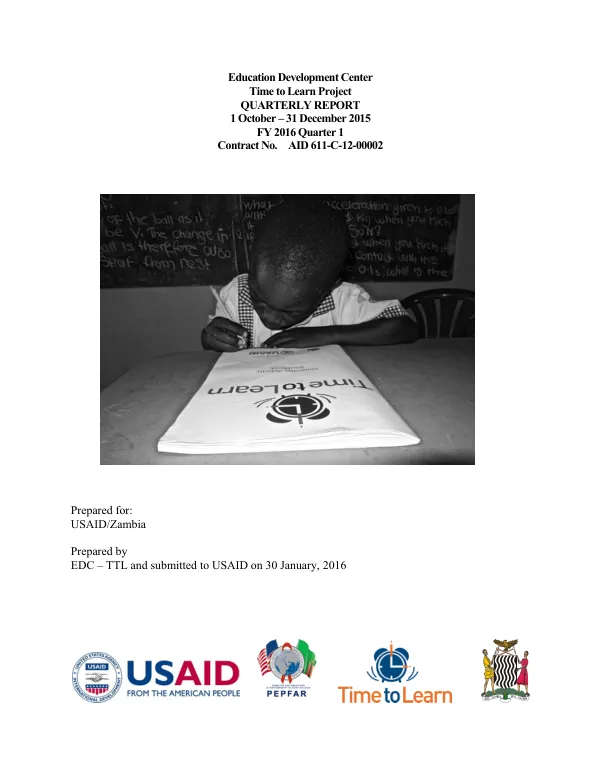
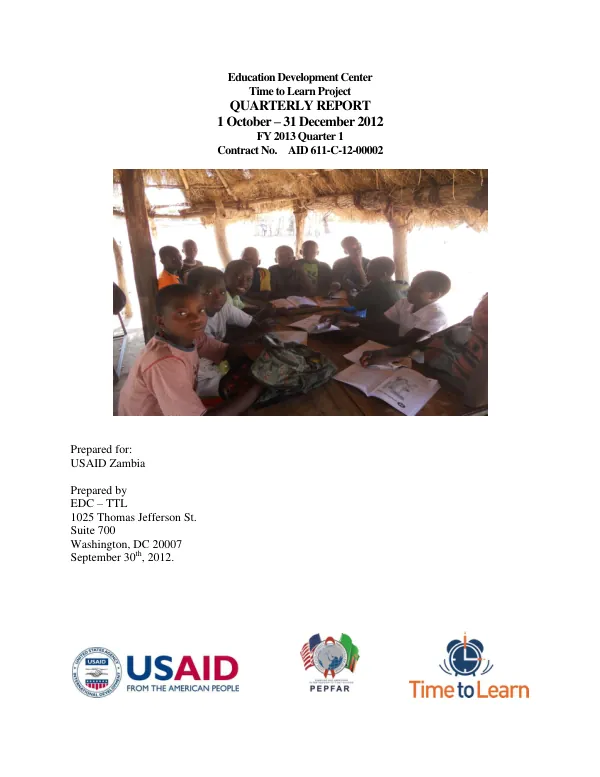
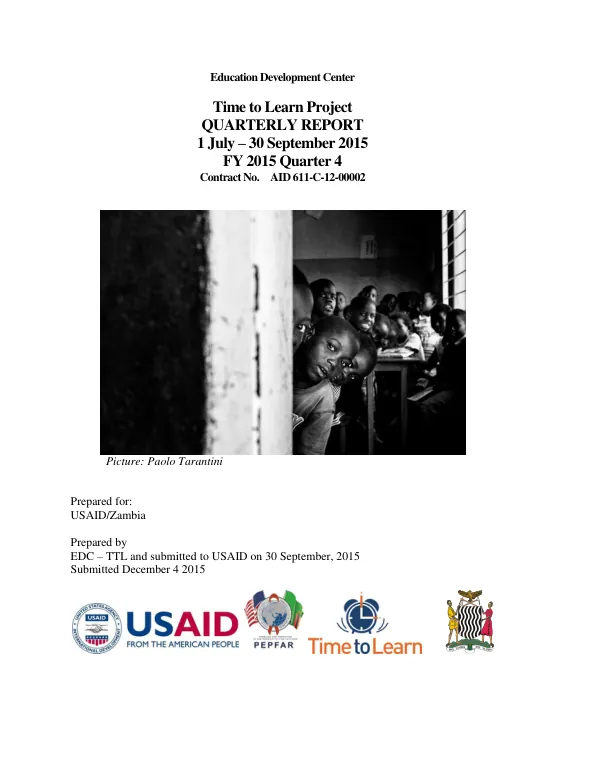
Quarterly Report: Time to Learn Project FY 2015 Quarter 4
The Time to Learn Project is a USAID/Zambia education program aimed at improving educational outcomes among orphaned and vulnerable children (OVC) enrolled in community schools.
2015 · 38 pages
Sign in to readA free account is required to download.
Abstract
The project partners with the Ministry of Education, Science, Technology, Vocational Training, and Early Education (MESVTEE) to develop an effective, replicable, and sustainable model for improving reading performance and responding to the economic, social, and psychological complexities faced by OVC. This includes providing scholarships to assist OVC to transition from community to government schools. The project's key purpose is to sustainably improve the quality of education in community schools and institutionalize, in a decentralized way, MESVTEE support to community schools to stabilize their operations. This is being done by providing educational resources, improving teacher skills and school management, and enhancing learner support through community and private sector participation. Addressing four key task areas, TTL assists the MESVTEE to promote a favorable environment for MESVTEE engagement at all levels to support community schools, promote HIV/AIDS prevention and provide a continuum of educational and financial support to enable OVC to participate in upper basic and secondary education, develop the capacity of local community groups and NGOs to advocate for opportunities for children in greatest need, and support opportunities to engage universities and other institutions in research related to promoting educational opportunities for OVCs. During the 4th quarter of FY 2015, the project achieved several milestones. The major event of the quarter was the National Symposium on Community Schools, which gathered more than 130 participants during 2 days in Lusaka. The Operational Guidelines for Community Schools were finally signed by the MESVTEE Permanent Secretary. TTL drafted the content relating to Community Schools for the Education Act/Education Policy in consultation with other stakeholders. TTL conducted a meeting with all 10 PEOs in Lusaka to review the TTL work plan and PEO/DEBS priorities for Community Schools. TTL participated actively in the planning, preparation, and activities of the Literacy Week at the National and Provincial levels. During the Literacy Week, TTL donated 121,196 teaching and learning materials for Community Schools in Luapula province. TTL conducted a series of dissemination events for midline evaluation results at the provincial level. 263 (127 M/136 F) Community School Teachers were trained in literacy instruction with mobile phones and instructional videos as a medium for the training. Head teachers trained teachers in their schools. TTL with PEO/DEBS officials visited Secondary Schools and paid scholarships for 2,049 (1,074 M / 975 F) Orphans and Vulnerable Children in grade 11. The project also made significant progress in training teachers and administrators. 263 (127 M/136 F) teachers were trained in the phone literacy program, and 68 (26 M/42 F) teacher mentors and safe club overseers were trained in North Western Province. The project also supported the development of Parent-Teacher Associations or similar "School" governance structures, with 453 Parents Community School Committees (PCSC) assisted to conduct school self-assessment and School Improvement Plan. The project also provided scholarships to 2,049 (1,074 M / 975 F) Orphans and Vulnerable Children. The project's results table shows significant progress in several areas. The number of administrators and officials successfully trained with USG support exceeded expectations, with 95% attendance at both the Phone Based Literacy Instruction Training and the e-EGRA Instruct trainings of administrators/school Head Teachers. The percentage of zonal, district, provincial, and other MESTVEE entities monitoring community schools systematically increased to 94%. The number of learners in TTL-supported community schools with reading skill gains is also increasing, with 441,037 learners in grades 1-7 and 294,662 learners in grades 1-4 showing reading skill gains. The project also provided 402,657 textbooks and other teaching and learning materials (TLM) with USG assistance.
Related documents