THE CLOUDBURST GROUP
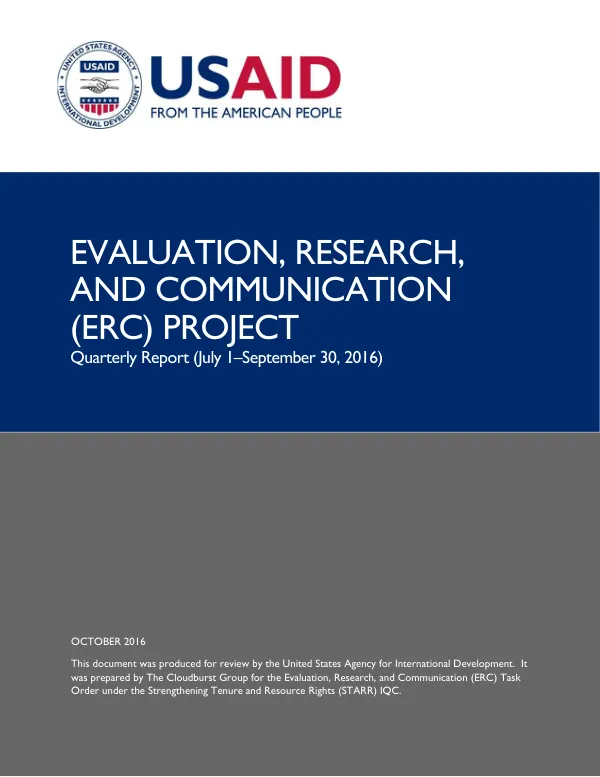
Quarterly Report Y4Q2 (July 1–September 30, 2016)
The Evaluation, Research, and Communication (ERC) project is a five-year Task Order under the USAID Strengthening Tenure and Resource Rights (STARR) Indefinite Quantity Contract.
2016 · 42 pages
Sign in to readA free account is required to download.
Abstract
The project aims to create, communicate, and apply evidence-based knowledge on best practices in land tenure and property rights (LTPR). ERC is implemented by Cloudburst Consulting Group, Inc. and supports USAID's Climate Change and Development objectives, including ensuring the rights and empowerment of local and indigenous communities. The project has five task areas, including impact evaluation, research, communication, training, and pilot activities. Under Task 1, ERC conducted evaluations of LTPR activities and components, and supported enhanced IE capacity of USAID staff. Task 2 focuses on providing rigorous evidence for LTPR theory of change and testing innovative approaches. Task 3 involves communicating LTPR-related messages, information, knowledge, and research results to raise awareness and promote cost-effective LTPR programming. During the second quarter of Year 4 (July 1 to September 30, 2016), ERC continued work on IE reports, drafted new pre-analysis plans, and prepared the USAID LandLinks portal for launch. The project also supported the National Land Observatory in Burkina Faso and received concept papers from participants in the Responsible Land-Based Investment pilot. Under Task 2, ERC submitted a draft brief on mutually beneficial contracting in large-scale land acquisition and continued work on three ongoing IE projects. The project also conducted a scoping trip to Indonesia for the evaluation of the Large-Scale Land Acquisition project. Under Task 3, ERC worked closely with sub-contractor Bixal to redesign the USAID Land Tenure internet portal and continued to develop strategic communications goals and procedures. The project's progress and learnings during this quarter align with the Year 4 work plan. The ERC project employs a multidisciplinary approach that aligns with USAID's Forward principles of learning and evidence-based programming, as well as gender equality and female empowerment. The project's objectives include improving food security and agricultural productivity, empowering women, addressing climate change, and promoting natural resource management. The project's geographic focus is on land tenure and property rights in various countries, including Indonesia, Liberia, and Burkina Faso. The project's timeframes are from May 2016 to April 2017, with quarterly progress reports submitted to USAID. The project's recommendations include promoting mutually beneficial contracting in large-scale land acquisition and supporting the development of evidence-based knowledge on LTPR. The project's implementation involves a multidisciplinary team of experts, including researchers, evaluators, and communicators. The project's budget is allocated to support the implementation of the five task areas, including impact evaluation, research, communication, training, and pilot activities. The project's outcomes are expected to contribute to the achievement of USAID's Climate Change and Development objectives.
Related documents