USAID DEC
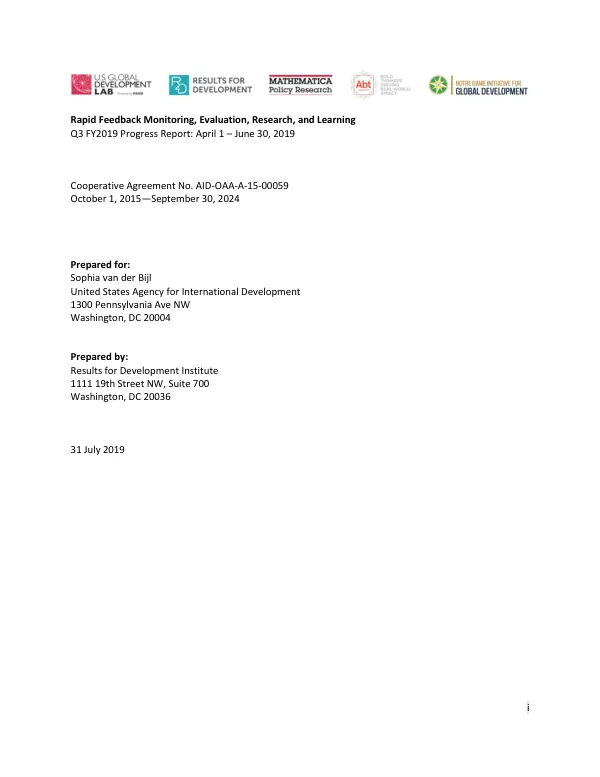
Rapid Feedback Monitoring, Evaluation, Research, and Learning Q3 FY2019 Progress Report: April 1 – June 30, 2019
Sign inABT ASSOCIATES
Rapid Feedback Monitoring, Evaluation, Research, and Learning Q3 FY2019 Progress Report: April 1 – June 30, 2019
Rapid Feedback Monitoring, Evaluation, Research, and Learning (RF MERL) is a program designed to improve rapid learning and adaptive management in the design and implementation of activities funded by the United States Agency for International Development (USAID).
2019 · 11 pages
Sign in to readA free account is required to download.
Abstract
The program addresses the lack of systematic testing and availability of timely evidence to inform ongoing activity refinement and improvement. RF MERL embeds rigorous monitoring, evaluation, and learning (MEL) approaches into activity design and implementation. A Consortium of four organizations—Results for Development Institute (R4D), Mathematica Policy Research, Abt Associates, and the Notre Dame Initiative for Global Development (NDIGD) – convened and supported by the U.S. Global Development Lab (the Lab) – is designing and testing the implementation of the RF MERL approach through up to 15 pilot engagements. The approach was developed as part of the Lab’s initiative to co-create and co-design development solutions that innovate on traditional MERL approaches. The Work Plan for the RF MERL Cooperative Agreement included four main activities: 1) Consortium management; 2) RF MERL framework development and pilot selection; 3) pilot implementation; and 4) synthesis and sharing. The RF MERL Consortium is responsible for coordinating technical and operational inputs for pilots, including the creation of concept notes, data collection tools, and initial data analysis findings for implementing partners. Coordinating technical and operational inputs for pilots involves R4D playing the lead role in coordinating technical inputs, such as the creation of concept notes, data collection tools, and initial data analysis findings for implementing partners. R4D serves as a liaison between the Consortium and USAID, which acts as the initial point of contact with each USAID Operating Unit. The Lab and R4D hold weekly calls and work closely on pilot generation and development, pulling in relevant Consortium members, as needed. The RF MERL Consortium has selected several pilot engagements, including the Tusome Pamoja pilot engagement in Tanzania. The Tusome Pamoja pilot engagement officially launched in Q3 FY2017 with a scoping trip to Tanzania. Options for the engagement were developed in May 2017 and the study design was finalized in February 2018. RF MERL completed Round 1 of data collection in Zanzibar and in the mainland regions of Iringa and Morogoro in 2018. The RF MERL Consortium collected data to understand how the Community Education Mobilization and Action Planning (CEMAP) process, Parent Teacher Partnership (PTP) formation, school committee capacity building, and Social and Behavior Change Communication (SBCC) activities have been implemented to-date. This quarter, RF MERL held several conversations with Research Triangle Institute (RTI), the implementing partner, and USAID/Tanzania to explore research priorities for Round 2 of data collection. The RF MERL Consortium has also selected the THALI engagement in India, which began in Q1 FY2017 with a scoping trip to India to kick off an engagement with Karnataka Health Promotion Trust (KHPT). The engagement has been designed to determine which patient characteristics are associated with non-adherence to TB medication for various technology adherence models. This engagement is designed to identify the risk factors of low engagement and adherence across four technology models: 99DOTS, where patients receive blister packets with medication and a mobile phone-based system to track adherence; SMS reminders to patients to take medication; a mobile phone-based system to track adherence; and a mobile phone-based system to track adherence and provide reminders. The RF MERL Consortium is responsible for coordinating the implementation of the pilot engagements, including data collection, analysis, and synthesis. The Consortium is also responsible for sharing the findings from the pilot engagements with USAID and other stakeholders. The RF MERL program aims to improve the effectiveness of USAID's activities by providing timely and relevant evidence to inform decision-making.