ROBERT R. NATHAN ASSOCIATES, INC.
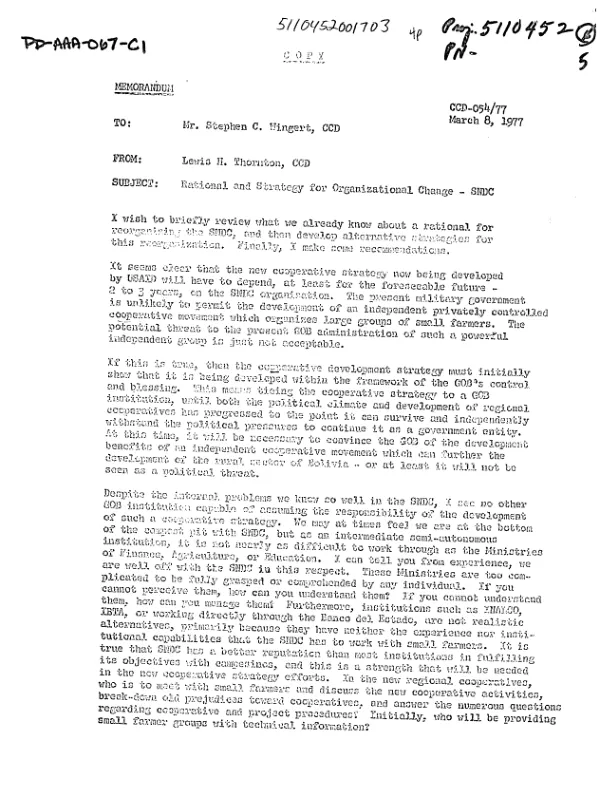
RATIONAL AND STRATEGY FOR ORGANIZATIONAL CHANGE - SNDC
Evaluates project performance from 1958 to 1977 in Bolivia.
THORNTON, LEWIS H. · 1977
Sign in to readA free account is required to download.
Abstract
The Natn'l Community Devel Service (SNDC) provides small farmers credit to increase agr productn & provide an economically viable infrastructure. Proj consultant gives his recommendatn for proj continuatn. Consultant feels that semi-autonomous intermediate institutns, such as SNDC, are the best system for Bolivia's rural devel & change. Despite SNDC's internal problems it has demonstrated the best organizatn for developing a coop strategy. Other rural institutns such as INALCO, IBTA, and Banco del Estado have not succeeded in serving small farmers since they lack experience & institutional capabilities; and Govt of Bolivia (GOB) institutions such as the Ministries of Finance, Agriculture, and Education are difficult to work through. Unfortunately, Bolivia's present military govt eliminates the developmt of an independent privately controlled coop movemt as originally planned. SNDC's survival in Bolivia will necessitate that it be developed within the framework of the GOB's control & blessings. GOB must be convinced of developmt benefits of an indepent coop movemt capable of developing Bolivia's rural sector. Proj consultant outlines 3 alternatives in developing SNDC's necessary reorganizatn. Alternative one, the most preferable but also the most timely & expensive, would involve redesigning SNDC into a well-staffed institutn capable of managing rural change. Alternative two, a partial organizational change involving less time, training, and funds, would result in some depts & field offices running sufficiently to keep proj out of trouble but not tackling SNDC's major organizational probs. Alternative three, which would do little more than keep SNDC together, would require continuous adjustmts in a few depts until a regional coop developmt system was implemented. Although consultant prefers alternative one, he feels alternative two fits the needs of USAID at this point & could be implemented within 2 to 3 years. Consultant feels alternative two can be implemented only if funds are sufficient. If funding is limited alternative three is preferable.
Related documents
Documents in this collection
 1977
1977USAID DEC
PROPOSAL FOR THE DEVELOPMENT OF A MANAGEMENT PROGRAM TO BUILD A CAPACITY INTO THE NATIONAL COMMUNITY DEVELOPMENT SERVICE (SNDC) OF BOLIVIA IN ORDER TO INCREASE ITS IMPACT UPON AGRICULTURAL PROGRAM T
Open record 1977
1977USAID DEC