USAID DEC
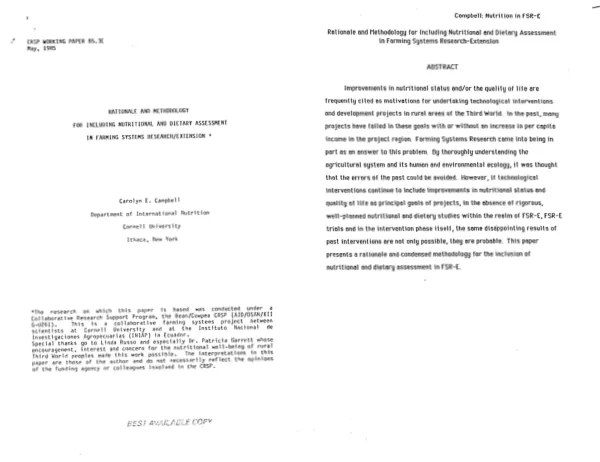
Rationale and methodology for including nutritional and dietary assessment in farming systems research/extension
Sign inCORNELL UNIVERSITY. DEPT. OF INTERNATIONAL NUTRITION
Rationale and methodology for including nutritional and dietary assessment in farming systems research/extension
A rationale and a three-stage methodology for including nutritional and dietary assessments in farming systems research and extension (FSR/E) is presented.
Campbell, Carolyn E. · 1985
Sign in to readA free account is required to download.
Abstract
Reasons for making such assessments include, inter alia, the importance of nutrition for infant/child health and education, the unacceptability of income as a proxy for nutritional status, and the disparity between the macro- and micro-level impacts of development projects. The paper also describes the three types of nutritional tests (biochemical, clinical, and anthropometric) and the difference between cross-sectional and longitudinal studies in measuring a population"s nutritional status; outlines methods for assessing dietary status (the 24-hour recall and food frequency methods, the study of food habits); and indicates the importance of seasonality for nutrition, especially in arid lands. The methodology for including these assessments in FSR/E consists of collecting (1) secondary data, (2) information from community leaders and other expert contacts, and (3) data from study households. A discussion of the types of questionnaires to be used in the household surveys is presented along with guidelines for writing and conducting the surveys. Special attention is given to timing the interview so as not to interrupt household activities and yet obtain representative information. Suggestions are also made for choosing a research team. A 40-item bibliography (1857-1984) is appended.