USAID DEC
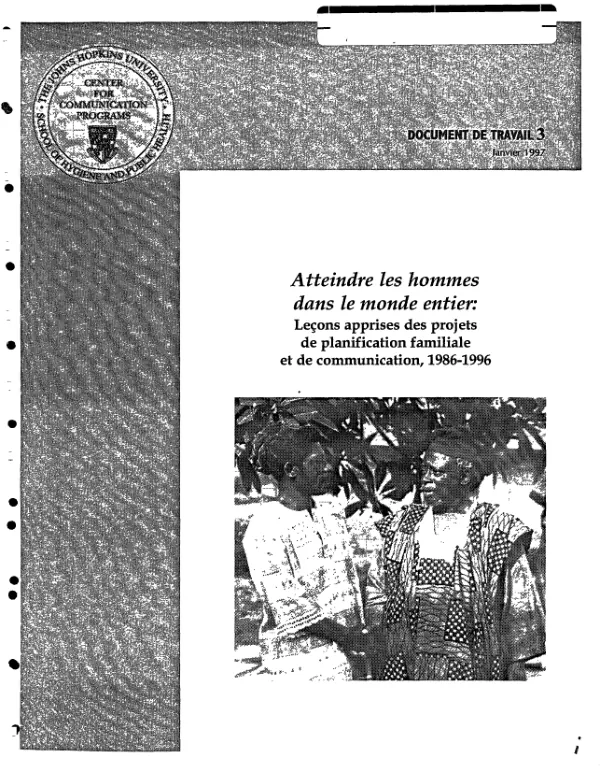
Reaching men worldwide : lessons learned from family planning and communication projects, 1986-1996
Sign inJOHNS HOPKINS UNIVERSITY, CENTER FOR COMMUNICATION PROGRAMS
Reaching men worldwide : lessons learned from family planning and communication projects, 1986-1996
Since 1986 Johns Hopkins University Population Communication Services (JHU/PCS) has supported more than two dozen programs addressing men"s participation in family planning (FP) and reproductive health.
Forsythe, Faith; Ndeti, Mwelu, comp. · 1997
Sign in to readA free account is required to download.
Abstract
This publication reviews such JHU/PCS projects in Africa, Asia, Latin America, the Near East, and the New Independent States, and presents the most important lessons learned from that experience. (1) Learn through research what men want and need. Men are a diverse audience with differing profiles concerning FP and reproductive health. Targeted, focused messages must be developed to increase their participation. (2) Present men as caring partners, not irresponsible adversaries. Research shows that the "macho" stereotype is often false. Playing to stereotypes can do a disservice to the audience and damage an FP campaign"s effectiveness. (3) Encourage men to talk to their partners and make joint decisions. Good communication between spouses is crucial to effective FP. (4) Publicize and promote service sites for men. Research shows that men need better access to information and service providers with whom they feel comfortable. (5) Improve men"s image of contraceptive methods. Communication campaigns must focus on factual information and perceptions to overcome myths or rumors that sometimes generate men"s opposition to certain forms of FP. (6) Work with opinion leaders to increase men"s social support and FP. (7) Use multiple communication channels. Research shows that individuals exposed to a message from multiple sources -- mass and community- based media, interpersonal communication -- are more likely to take action than those exposed to a message from a single source. (8) Pay attention to young men. Young men just beginning sexual activity are especially vulnerable to sexually transmitted diseases, including HIV/AIDS. Addressing their needs can have a potentially large impact on their lives and those of many others. (Author abstract, modified)