USAID DEC
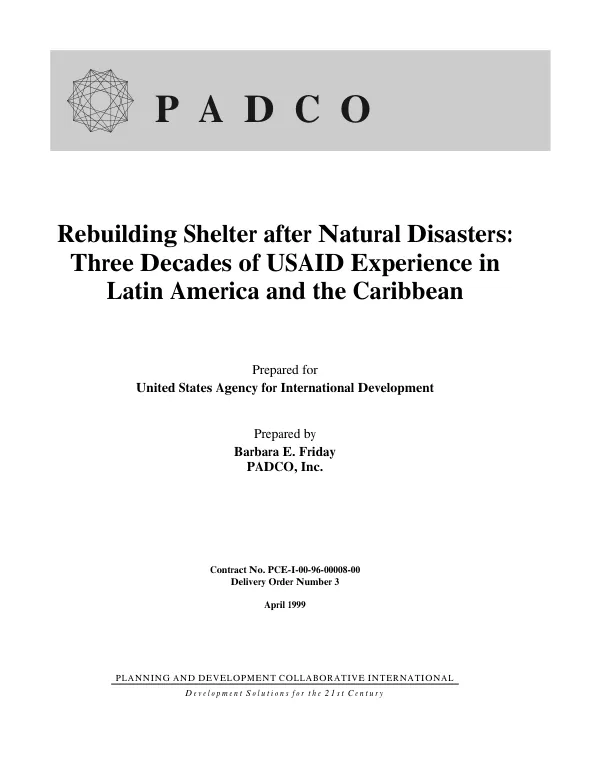
Rebuilding shelter after natural disasters : three decades of USAID experience in Latin America and the Caribbean
Sign inPLANNING AND DEVELOPMENT COLLABORATIVE INTERNATIONAL, INC. (PADCO)
Rebuilding shelter after natural disasters : three decades of USAID experience in Latin America and the Caribbean
This report examines USAID"s experience in natural disaster preparedness/response in Latin America and the Caribbean (LAC) over the past three decades, with a focus on shelter reconstruction.
Friday, Barbara E. · 1999
Sign in to readA free account is required to download.
Abstract
The paper offers concrete lessons learned, recommends ways to analyze the environment in which reconstruction takes place, and suggests how to work with the multiple actors who take part in the reconstruction process. To the extent possible, the data are compared across countries. Lessons learned, which are organized according to the disaster planning and response cycle (relief, reconstruction, evaluation, and planning and preparation for future natural disasters), are provided in the following categories: (1) types of natural disasters; (2) what to do during emergency and relief; (3) how to approach the reconstruction phase; (4) materials for and access to shelter; (5) shelter reconstruction and sustainable development; (6) reconstruction and economic development; and (7) information dissemination. According to the report, those who suffer most from natural disasters are the poor, who live in unsafe homes and vulnerable locations, and who do so because these are the most rational options available to them. An important role for the international community is to work with local governments, the private sector, and civil society to create a menu of shelter options that are safe, affordable, and accessible, and that can provide the foundations for continuous improvement. Includes references and a bibliography.
Related documents