USAID. BUR. FOR LATIN AMERICA AND THE CARIBBEAN. REGIONAL OFC. FOR CENTRAL AMERICAN PROGRAMS (ROCAP)
Regional coffee pest control
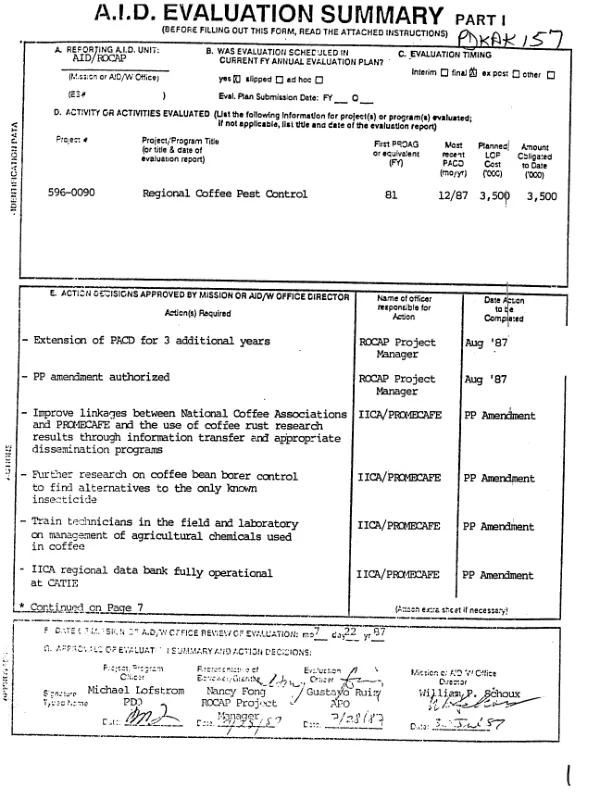
Summarizes attached final external evaluation of a project to develop and implement an integrated pest management program to control coffee rust and the coffee berry borer in Central America.
Lofstrom, Michael; Fong, Nancy · 1987
Sign in to readA free account is required to download.
Abstract
Evaluation covered the period 6/81-4/87 and was based on document review, site visits, and examination of financial records. The project has been well-managed and very successful; its training, research coordination, and information transfer activities have won the support of participating national coffee institutes and Ministries of Agriculture and have created a level of technical competence and confidence at the national level. The project"s major accomplishments include: (1) training more than 1,200 participants in over 30 national and regional workshops; (2) developing a new method for reproducing microcuttings which is now ready for commercial testing; and (3) finding ways to reduce the amount of chemical needed to control coffee rust by 30%, thus reducing in turn annual control costs to about $36-45/ha. In addition, work in progress promises to develop a number of rust-resistant lines in the next 3 years. Taken together, the project"s advances in microcuttings and varietal research make it one of most advanced coffee development programs in the world. Extension training activities have surpassed project goals, improving technical understanding of modern coffee production and integrated pest management even among small farmers, although much remains to be done to improve information dissemination to potential users. Also, further research is needed on chemical control of the coffee berry borer and on means of reducing pesticide residues. The project teaches that a flexible management style is needed in order to adapt to changing research and/or socioeconomic conditions and that programs such as this should include mass dissemination components as well as networking activities that provide participants with the widest possible exposure to formal and informal learning opportunities. Action decisions are to extend the PACD for 3 years and during this extension to focus on, inter alia: improving information transfer (at all levels) and linkages with national coffee associations; continued research on coffee bean borer control, rust control, and pesticide residues; and training technicians in the use of agricultural chemicals.