USAID. MISSION TO GUATEMALA
Regional environmental and natural resources management (RENARM)
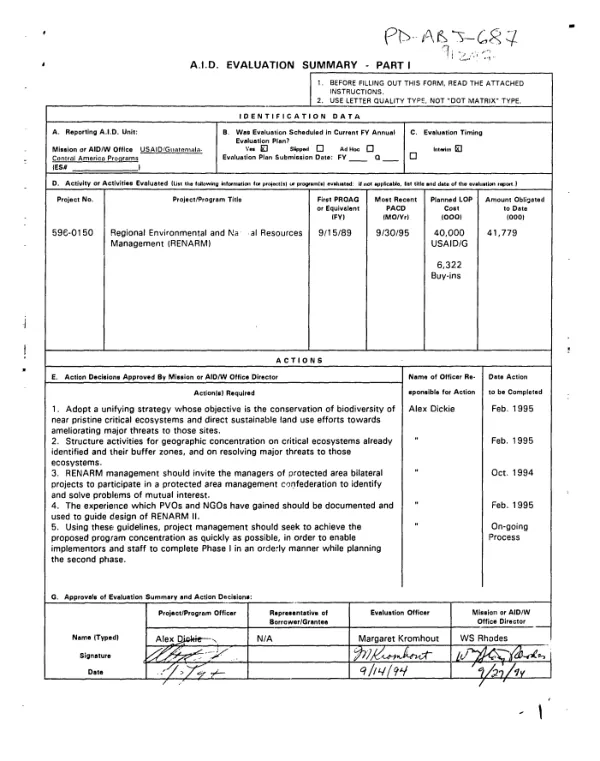
Summarizes interim evaluation of a project (XD-ABJ-687-A) to promote sustainable environmental/natural resource (E/NR) management in Central America.
1994
Sign in to readA free account is required to download.
Abstract
The evaluation covered the period 1989-1993. The project is a complex and experimental activity, involving more than 20 implementors performing multiple activities in 8 countries. Its three main purposes are to get a handle on Central American E/NR policy, to involve U.S. PVOs in Central American E/NR programs, and to focus regional institutions (particularly CATIE -- the Tropical Agricultural Research and Training Center) on E/NR. It is well on its way to accomplishing all three objectives, although few activities are complete or will realize their full potential by the 9/95 PACD. The policy component has (1) created a participatory policy analysis package (The Green Book Complex), which is being used to help NGOs and governments to understand the effects of different policies and decide whether to advocate changes; (2) established a network of legal experts, inventoried Central American E/NR laws, and drafted a model law to facilitate multinational parks; (3) supported the Central American Council on Environment and Development (CCAD) in, inter alia, drafting E/NR agenda for Central American Presidential Summits, developing a Tropical Forestry Action Plan, and promoting development of a NAFTA-like agreement between Central America and the United States; and (4) strengthened the national councils on environment and development (CONAMAs). The component to involve U.S. PVOs in Central American E/NR issues is being implemented by two consortia: PACA and PASEO Pantera. PACA, which employs the model of a U.S. PVO working with local NGOs to manage a protected area and a buffer zone, has established model programs in Guatemala, Belize, Honduras, and Costa Rica, with functional foci on environmental policy and information, environmental monitoring, and public awareness. Thanks in part to PACA, environmental awareness is higher now in Central America than ever before. PASEO"s program is the most innovative and risky of the entire project, since its focus is almost entirely on the wetter, more fragile Caribbean side of the isthmus. PASEO counteracts this risk by investing small amounts of funds in a wide variety of actors. PASEO has had both spectacularly successful innovations (the Biodiversity Legal Project, Rio Platano-Tawahka Sumo Awareness Campaign) and solid accomplishments (Bay Islands and Tortuguero environmental education, Bay Islands land use study). A few of PASEO"s major concepts are in advanced stages of development; four are particularly intriguing: ecotourism, environmental education, buffer zones, and the notion of a Central American biological corridor stretching from Mexico to Panama. CATIE is involved in a variety of programs: (1) a pesticide management program consisting of integrated pest management technology activities and an educational program; (2) a program to demonstrate that management of natural forests as commercial enterprises is not incompatible with conservation of protected areas; (3) a program to promote the growing of trees for the production of poles, posts, and saw-logs, with fuelwood as a byproduct (MADALENA III); and (4) an impressive watershed management program which has applied land use planning techniques and demonstrated successful technology for sustainable hillside agriculture in four countries. Cross-cutting educational and research activities include: (1) M.S. training in environmental education for 14 persons, along with team-building activities to create a post-degree network; (2) CATIE"s M.S. program, the premier postgraduate agricultural school in Latin America, awarding 20-50 degrees per year; (3) The Nature Conservancy fellowships for NGO staff managing protected areas; and (4) Wildlife Conservation Society"s small research grants to Central American scientists. The Mission has decided to focus a follow-on project around two unifying principles: a Central American biological corridor; and preparation for an environmental side agreement to a possible Western Hemisphere Free Trade Agreement.
Related documents
![PACA [proyecto ambiental para Centro America] final evaluation workshop -- proceedings synthesis : Belize, Costa Rica, Guatemala, Honduras -- cooperative agreement no. 596-0150-A-00-0586-00, 1990-1995](https://covers.devme.ai/gen/6851.webp)