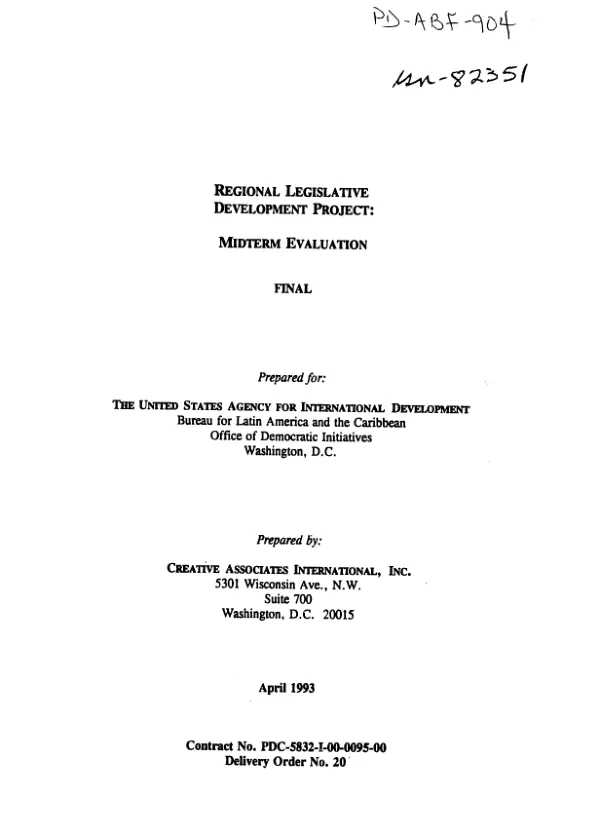
CREATIVE ASSOCIATES INTERNATIONAL, INC. (CAII)
Regional legislative development project : midterm evaluation
Evaluates a project to strengthen legislatures in selected Latin American and Caribbean (LAC) countries.
1993
Sign in to readA free account is required to download.
Abstract
Interim evaluation covers the period 8/90-9/92 and focuses on the core regional project managed by the Consortium for Legislative Development, comprising The Center for Democracy, Florida International University, and State University of New York/Albany. While the project design is valid, implementation has been weak due to severe problems in intra-Consortium management, compounded by communication problems with USAID and lack of an overall strategic plan for the project. Findings concerning the project's five main components are as follows. (1) The Consortium was to conduct needs assessments of the training, TA, and equipment needs of legislatures in ten countries, but reported activities in only eight. Of these, three assessments, in Costa Rica, Nicaragua, and Panama, were satisfactory and led to a buy-in or bilateral agreement. However, the other five, in Guatemala, Haiti, Dominican Republic, Bolivia, and Paraguay, were nonsubstantive and provided no basis for developing extensive projects. According to the Consortium, these assessments were conducted in accordance with A.I.D./W's instructions. (2) The Consortium has conducted two regional seminars, four subregional seminars, and three orientation programs on technical topics and legislative development. The quality of the seminars varied widely; several were criticized by A.I.D. and participants for lack of preparation, organization, and language capability of the presenters. Most successful were the orientation seminars and a grant writing seminar requested by ATELCA, the Guatemala-based Association of Central American Legislative Technicians. (3) Design of management information systems and short-term TA were also part of the Consortium's contract. While some management and legislative information systems were assessed (in conjunction with the country needs assessments), none have been designed. Short-term TA has been provided on request to legislatures in Paraguay, Guatemala, the Dominican Republic, Belize, and Haiti, in several cases on short notice. Most successful was the provision of Spanish-speaking information specialists, who were well received. (4) Graduate education in legislative development was offered through a program at SUNY/A; participants were selected to participate in a Master's program in Legislative Administration or a certificate program. While participants consider the training to be valuable, better procedures for selecting candidates are needed. (5) The Consortium has supported ATELCA, beginning with the Third General Assembly in El Salvador in 11/90. Although regional legislative personnel feel that the very existence of ATELCA has increased the stature of legislative staff throughout the region, ATELCA suffers from a lack of infrastructure, disagreement on criteria for membership, and financial dependence on A.I.D. Legislative staff and the legislatures they serve have not yet become committed enough to sustain ATELCA absent external funding. Lessons learned include the following. (1) Projects must maintain a measure of flexibility to accommodate the changing needs of legislatures, which are fluid organizations with frequent, sometimes yearly, changes in leadership. (2) Regional projects should be implemented through institutions that have sufficient organizational, technical, and programmatic capabilities and familiarity with A.I.D. requirements. An inventory of such organizations with skills in legislative development should be developed for A.I.D. It is important that A.I.D. not reject the objective of strengthening legislatures because of the performance of the Consortium. Improving the image, capacity, and efficiency of legislatures requires a long-term commitment. In addition, A.I.D. should consider the continuation of a small amount of institutional and programmatic support to ATELCA, while requiring measurable progress toward self-sufficiency.
Related documents