USAID DEC
Removing Taxes for Contraceptives in Madagascar: Strategic Advocacy Leads to Increased Budget for Family Planning
Sign inDFID
Removing Taxes for Contraceptives in Madagascar: Strategic Advocacy Leads to Increased Budget for Family Planning
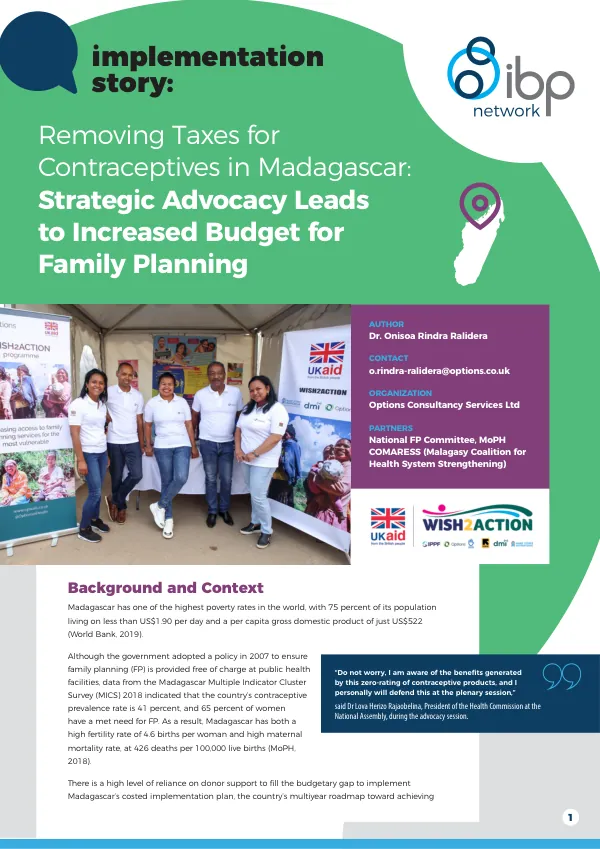
The removal of taxes on contraceptives in Madagascar was a strategic advocacy effort led by Options Consultancy Services, in collaboration with the National FP Committee, MoPH, and COMARESS.
2021 · 4 pages
Sign in to readA free account is required to download.
Abstract
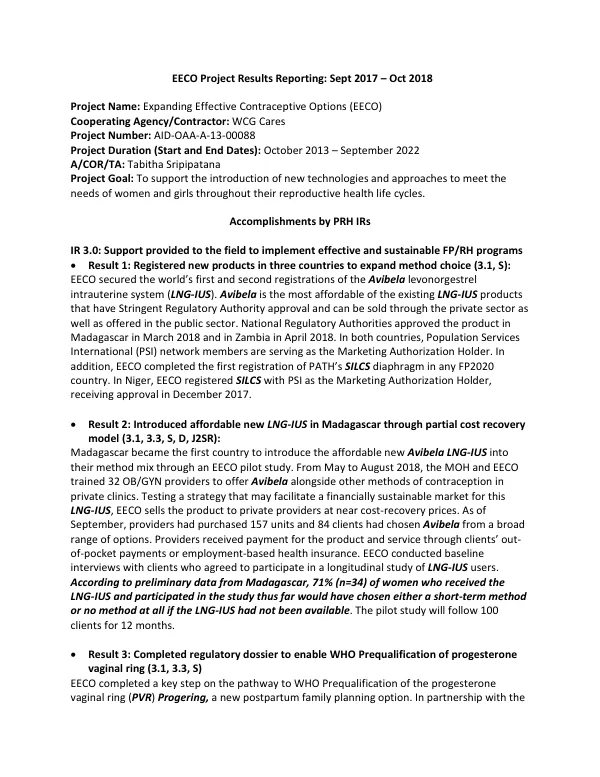
The initiative aimed to increase domestic financing for family planning (FP) and reduce the country's reliance on donor funding. Madagascar has one of the highest poverty rates in the world, with 75 percent of its population living on less than US$1.90 per day. The country's contraceptive prevalence rate is 41 percent, and 65 percent of women have an unmet need for FP. As a result, Madagascar has a high fertility rate of 4.6 births per woman and a high maternal mortality rate of 426 deaths per 100,000 live births. The government's costed implementation plan for FP is heavily reliant on donor support, with technical and financial partners donating 95.5 percent of FP commodities. The Ministry of Public Health (MoPH) covers the remaining 4.5 percent and must pay an estimated US$94,000 annually in taxes on donated commodities. By removing taxes on FP commodities, the government could use the savings to increase the state budget for contraceptives or finance other parts of the costed implementation plan. Options used the Domestic Public Financing High Impact Practice to create a more enabling environment and shift toward more efficient use of public financing. The organization consulted with key decision makers, including the president of the National Health Commission at the National Assembly, to advocate for the removal of taxes on FP commodities. Additional partners from the WISH2ACTION program and MoPH's FP Department joined Options to create the Malagasy Coalition for Health System Strengthening (COMARESS), an accountability mechanism to advocate for the removal of FP taxes. The MoPH initiated the process for removing the FP commodity taxes by sending a request to the Ministry of Economy and Finance (MoEF). A technical team from MoPH worked on incorporating an article on the removal of taxes into the draft 2020 Finance Law. Members of the National FP Committee, including technical and financial partners, then worked together to fulfill the request and refine the article. The National Assembly's voting process consists of two stages: committee work and plenary voting. Options, COMARESS, and the Head of the FP Department in the Directorate of Family Health organized an initial advocacy session with the President of the Health Commission. The president of the Health Commission successfully presented key economic arguments during plenary sessions to the President of the Finance Commission, which were backed by solid evidence and showed how the removal of taxes would lead to a loss of income in the state budget. The removal of taxes on FP commodities in the 2020 Finance Law was ultimately a result of strategic advocacy. The initiative highlighted the risks associated with an overreliance on donor funding for FP commodities and the gaps between government commitments and actual spending. Options developed a clear understanding of the annual budget cycle and political system, identified key stakeholders and champions to engage with, presented compelling arguments for investing in FP, and coordinated advocacy efforts at the parliamentary level for the removal of taxes on FP commodities. The additional funding now available for voluntary FP can help make the country's reproductive health (RH)/FP Law a reality, having an immediate impact on FP access as well as a long-lasting health and economic impact. To date, the government has not approved the reallocation of funds to purchase more FP commodities or increase its FP program, and an important next step is to ensure these available funds are used for FP. Options is now working with COMARESS and the MoPH to track how these funds are being used and to establish an advocacy strategy to advocate for their use to purchase FP commodities.
Related documents