CHEMONICS INTERNATIONAL, INC.
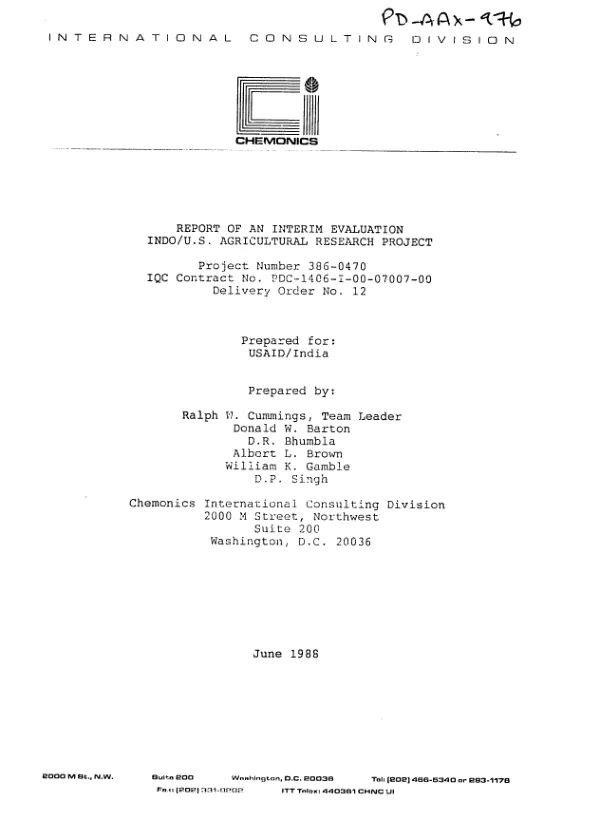
Report of an interim evaluation : INDO/US agricultural research project
Evaluates project to support collaborative agricultural research between Indian and U.S.
Cummings, Ralph W.; Barton, Donald W. · 1988
Sign in to readA free account is required to download.
Abstract
research scientists and institutions. Interim evaluation covers the period 6/83-4/88. The project has initiated seven subprojects (SP"s) - soybean processing, postharvest technology, embryo transfer, biodegradable waste, blood protista, forestry training, and the Project Implementation Unit (PIU) - and has initiated action on an eighth (plant genetic resources); five others are designed, but not approved, and one remains to be designed. It is still too early to assess the project"s impact on Indian agriculture, but the project"s design and concept are strong, and its purposes will probably be achieved. Implementation has been and continues to be delayed by problems in timing inputs. For example, Indian scientists wanted to schedule their U.S. training so that equipment purchased under the project would be available on their return, and they wanted the U.S. consultancies to begin after staff training, installation of equipment, and (in some cases) after new facilities construction had been completed. Given the length of time needed to procure equipment from the United States, this has become a major bottleneck. The Indian Council of Agricultural Research (ICAR) contributed to the delays by failing to provide adequate staffing and support for the PIU, which serves as the GOI counterpart to USAID/I for the project. Some of these delays were alleviated in 1986 by the appointment by USAID/I, with funding outside the project, of a Management Support Services unit, which has been helpful in arranging U.S. training, identifying consultants, and purchasing equipment outside India. ICAR commissioned a review of operational problems by the Indian National Academy for Agricultural Research Management in 1986, but its findings and recommendations have not received much attention. Recommendations are, inter alia, to (1) more evenly divide available funding among SP"s and reach a decision about which if any additional SP"s are to be included in the project; (2) use joint U.S.-Indian teams to design SP"s; and (3) hold discussions between USAID/I and ICAR to ensure that ICAR meets its commitment and that the PIU is brought into full operation. Although the project design was highly appropriate at the time of its development (when Indo-U.S. cooperation in agriculture was being reestablished), future collaborative efforts should not rely solely on this model. A number of larger stand-alone projects which are already evolving could provide a better framework for truly collaborative research with longer-term benefits. Also, future cooperative research efforts should receive financial commitment from both sides for at least 10-15 years and should involve greater collaboration with Indian state agricultural universities.