USAID DEC
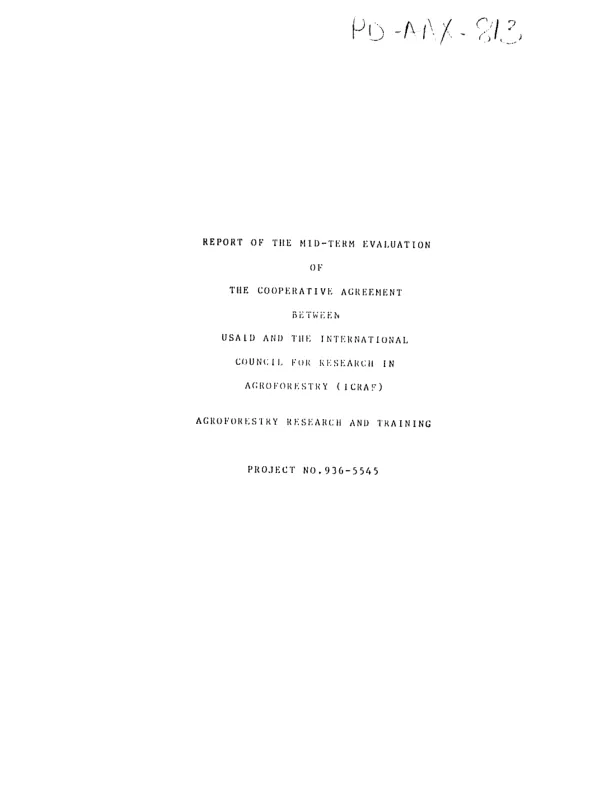
Report of mid-term evaluation of the cooperative agreement between USAID and the International Council for Research in Agroforestry (ICRAF)
Sign inUSAID. BUR. FOR SCIENCE AND TECHNOLOGY. OFC. OF FORESTRY, ENVIRONMENT AND NATURAL RESOURCES
Report of mid-term evaluation of the cooperative agreement between USAID and the International Council for Research in Agroforestry (ICRAF)
Evaluates collaborative research grant with the International Council for Research in Agroforesty (ICRAF) to (1) develop and test diagnostic methods to identify agricultural and forestry land use problems; (2) document worldwide agroforestry systems; and (3) develop and carry out training courses in agroforestry.
1970
Sign in to readA free account is required to download.
Abstract
Mid-term evaluation covers the period 3/82-3/84. Project purposes have been implemented as scheduled and progress has in some cases exceeded what was projected in the Project Paper. A field tested Diagnostic and Design Methodology (D&D) has been developed and published in two ICRAF working papers. Curricula and materials for training courses have been developed, and 20 participants have been trained so far. Only the documentation component has lagged behind, hampered by problems inherent in standardizing worldwide data and delays in international mail. These problems in no way jeopardize the final completion of the component, however, which should occur during a six-month unfunded project extension. ICRAF has a major role to play in improving land use and sustaining small to medium size farm operations in LDC"s. It should move more directly into technology generation, however, as opposed to the synthesis and evaluation of existing technology. Towards this end, ICRAF has already established a network of research projects under its Collaborative and Special Projects Program (COSPRO) where its scientists could be assigned and work directly on applied research activities. ICRAF should also give more attention to higher input agroforestry technologies and small to medium sized market-oriented operations (as opposed to subsistence level technologies and operations). In the future, A.I.D. should encourage ICRAF to expand its training capacity, especially by providing assistance to forestry and agronomy schools in curriculum design, developing educational materials, and training teachers at the diploma and degree levels in agroforestry. A.I.D. should also provide some assistance to the COSPRO program, perhaps by funding a series of research projects under different ecological and climatic conditions that would produce new technologies. Finally, A.I.D. should improve USAID Mission access to ICRAF expertise, perhaps by altering existing procurement and contracting requirements. (Author abstract, modified)
Related documents