USAID DEC
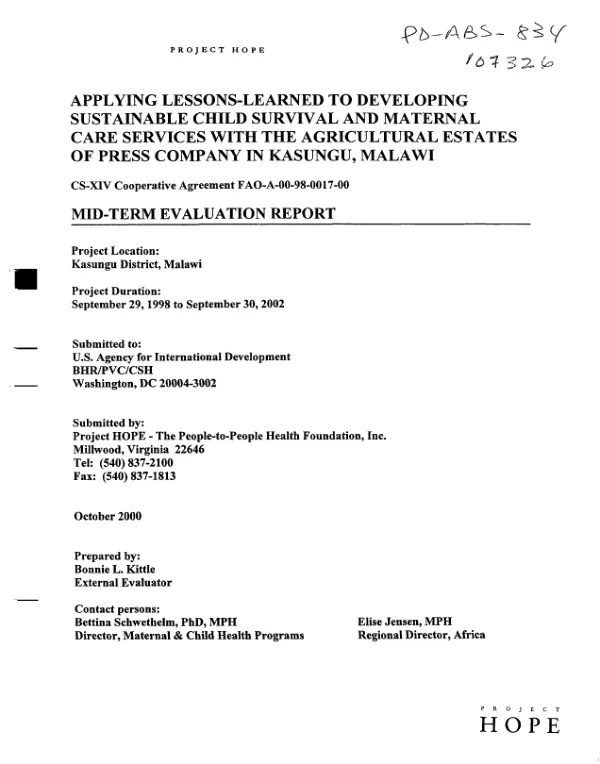
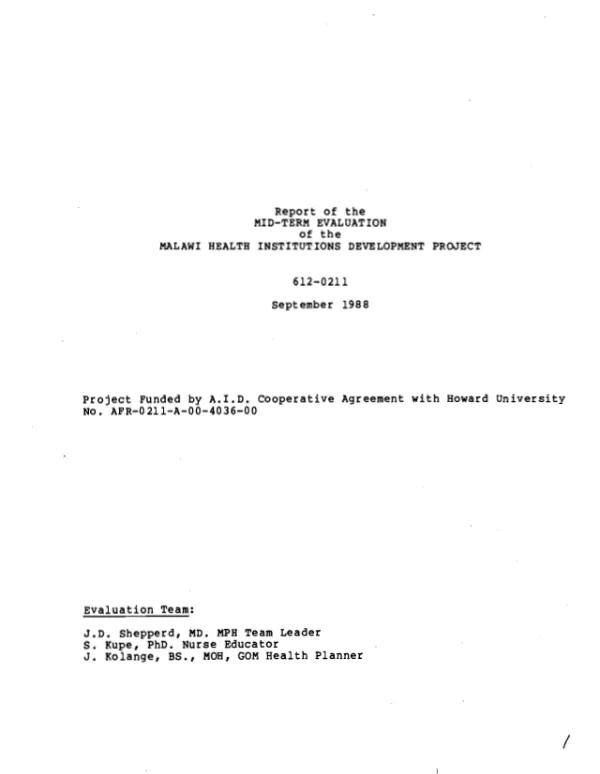
Report of the mid-term evaluation of the Malawi health institutions development project
Sign inUSAID. MISSION TO MALAWI
Report of the mid-term evaluation of the Malawi health institutions development project
Evaluates a project to provide inservice and pre-service training to rural health personnel in Malawi.
Shepperd, J. D.|Kupe, S.|Kolange, J. · 1988
Sign in to readA free account is required to download.
Abstract
All health workers will receive training in family health, while specific programs will be implemented for enrolled community health nurses, health assistants, and medical assistants. Mid-term evaluation covers the period 1984-9/88. Overall, the project has been carried out in an outstanding manner and has greatly pleased the Government of Malawi with its accomplishments. The family health component, larger than all other components combined, has trained an impressive number of health workers and has met rapidly growing needs with a well-organized, comprehensive, and smoothly administered program. The project's pioneering effort in the enrolled community health nursing component has been very successful in the quality and quantity of nurses trained. For both the family health and community nurse components, the project has made efforts to ensure high quality training and service by preparing protocols and conducting monitoring/supervisory visits to the graduates. The health assistant program has made substantial progress through a relatively stable group of trained tutors. In-service training was provided to the 164 existing health assistants and pre-service training capacity was increased from 10-12 to 40 per year. On the negative side, there is serious doubt about the sustainability of the medical assistant training component. Inputs to this program lag behind all other components, and the turnover rate among tutors has been high. The program is also fragmented, with preclinical training provided at the Lilongwe School of Health Sciences (LSHS) and clinical training in Blantyre. There is also some evidence of instability at LSHS, the primary provider of pre-service training for the project. LSHS staff members are transferred to the school by the Ministry of Health for temporary assignments, and most feel a lack of career opportunity at the school. Major recommendations are to redesign and extend the project to 12/91 to permit training of health surveillance assistants and to improve the LSHS's curricula in other areas (i.e., clinical officers, pharmacy assistants, dental assistants) and to ensure sustainability of project components.
Related documents