AMERICAN PUBLIC HEALTH ASSOCIATION. INTERNATIONAL HEALTH PROGRAMS
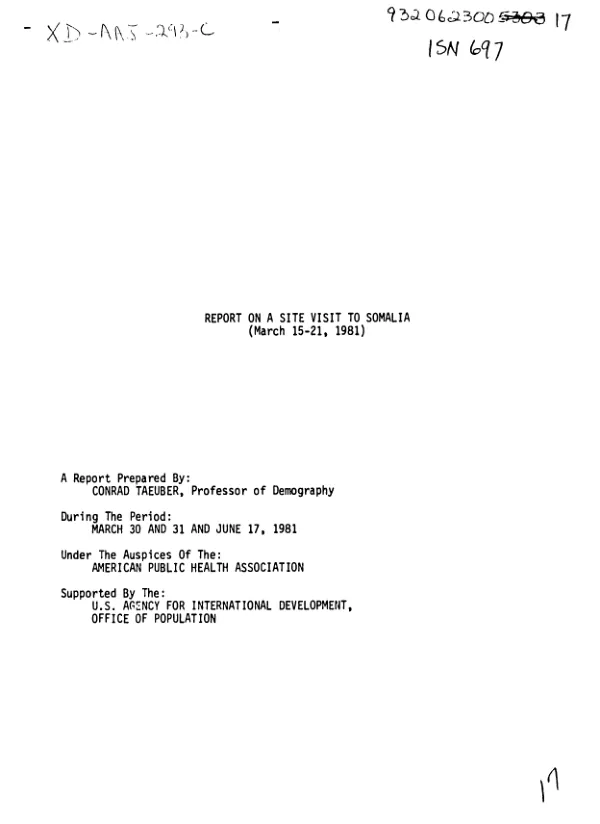
Report on a site visit to Somalia
Evaluates project to conduct a demographic survey in Somalia as part of a larger project of the International Program of Laboratories for Population Statistics of the University of North Carolina (POPLAB/UNC).
1981
Sign in to readA free account is required to download.
Abstract
Country report, attached to a special evaluation (PD-AAJ-293), covers the period 1/80-3/81 and is based on a site visit to the subcontractor, the Somalian Central Statistics Department. The survey is on schedule and within the planned budget. Survey samples were drawn with great care, despite serious difficulties in the field and the lack of good maps. from government offices and trained in survey methods. Substantial support for the interviewers in the form of transportation and supplies was provided by the GOS. Field conditions were harsh; work was delayed by numerous vehicle breakdowns, heavy rains, and occasional sickness of team members. The identification of the locations and size of water points and villages proved to be very difficult and more government support in this area would have been helpful. The extensive duties of the team supervisors included being responsible for food, transportation, general supplies, and the review of completed questionnaires. POPLAB/UNC staff have made short-term visits to Somalia to provide technical assistance and have demonstrated both their ability to work as a team and their sensitivity to the technical needs of their Somali counterparts. Turnover among the Somalis in charge of the project has been high; POPLAB/UNC has assumed more responsibility for some work than initially planned, although the project is still on schedule. Much of the fieldwork has been completed and remaining activities are well under way, although unexpected rains prevented complete interviewing of targeted nomadic households and may cause the nomadic population to move out of areas where water is concentrated - the principal areas selected for sampling. A manual review of returned questionnaires, which are essentially legible and complete, revealed no major problems and a computer check for errors has begun. Sampling instructions seem to have been followed carefully. Tabulation, however, is expected to be a problem because many respondents could not provide the desired information. There is a substantial concentration of ages divisible by five and ten and it will be necessary to develop data analysis procedures which take this factor into account.