DEVELOPMENT ASSOCIATES, INC.
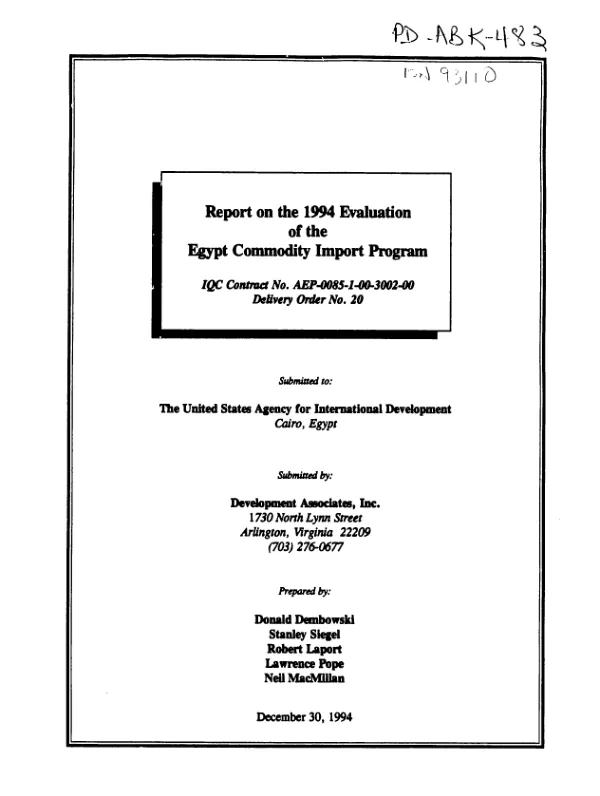
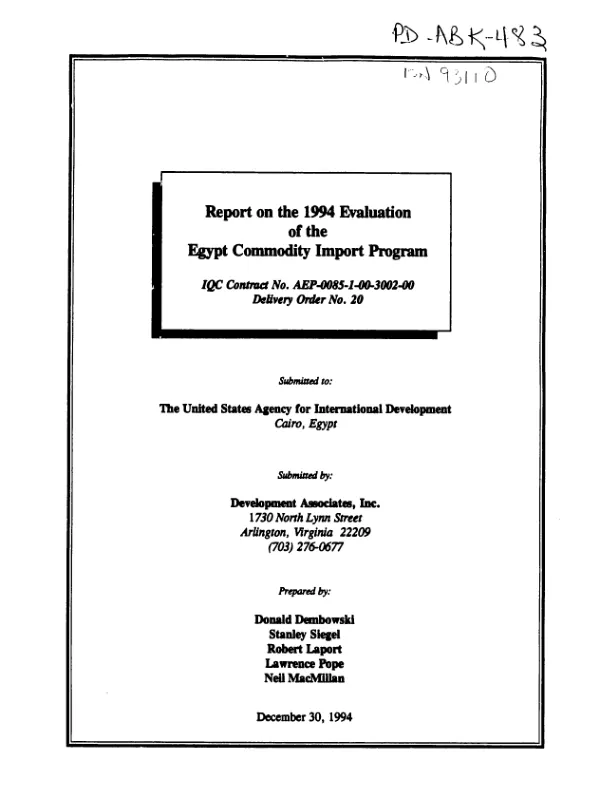
Report on the 1994 evaluation of the Egypt commodity program
Evaluates Commodity Import Program (CIP) assistance to Egypt.
Dembowski, Donald; Siegel, Stanley · 1994
Sign in to readA free account is required to download.
Abstract
Evaluation covers the period 1975-91 for the program"s public sector component (PUCIP), and 1986-12/94 for its private sector component (PRCIP). Together, PUCIP and PRCIP have accounted for $5.3 billion in aid since 1975, or about one-fourth of the total amount of Economic Support Fund (ESF) assistance provided to Egypt. PUCIP expenditures have totaled $4 billion, with capital goods accounting for one-third of total expenditures, and bulk goods for one-quarter. PUCIP was terminated in 1991, although an existing pipeline is still being drawn down. PRCIP expenditures have totaled nearly $1.3 billion, with capital goods and bulk grains each accounting for about one-fifth of total expenditures. USAID paperwork and procedural requirements are a major headache for private importers, but they utilize the PRCIP due to its long grace period, coverage of the foreign exchange risk, and the quality of U.S. goods. Financial incentives to induce banks to participate in the program, on the other hand, are inadequate under current economic conditions. There has also been little effective publicity for the PRCIP, with some importers unaware of the grace period allowed and some thinking the program had been discontinued. The Project Finance Facility (PFF), which provides medium-term import credits related to plant modernization and/or expansion, is underused. Egypt"s stabilization and structural adjustment programs have had considerable impact on the CIP. Unification of the exchange rate in 1991 and the related build up of foreign exchange reserves eliminated the foreign exchange support justification for the CIP. The country"s restructuring process is continuing and could have further unforeseen impacts on the program. There is also growing competition to the PRCIP, due to a wider selection of import finance sources in Europe that offer goods comparable to the U.S. goods, at lower prices, with faster delivery. Congressional earmarking is also inhibiting effective use of PRCIP resources. The annual earmarking has led in recent years to imports of grain commodities, which are basically used as commercial rather than developmental goods. Despite its problems, the PRCIP remains politically and, due to the interest-free grace period, economically relevant, although it has had a limited impact on the economy due to its relatively modest scale. Still, PRCIP funding accounts for about 10% of total imports by Egypt"s private sector, and funds are mainly destined towards the growth sectors of the economy. The program is not adequately addressing the need to accelerate development of the private sector to spur increased economic growth. The PRCIP could be appreciably enhanced if it were aggressively marketed.
![Final [report] : impact analysis study -- USAID/Egypt commodity import program](https://covers.devme.ai/gen/23498.webp)
![Final [report] : impact analysis study -- USAID/Egypt commodity import program](https://covers.devme.ai/gen/5111.webp)