USAID DEC
Report on the midterm evaluation of the applied diarrheal disease research [ADDR] project
Sign inHARVARD UNIVERSITY. HARVARD INSTITUTE FOR INTERNATIONAL DEVELOPMENT (HIID)
Report on the midterm evaluation of the applied diarrheal disease research [ADDR] project
Mid-term evaluation of a project to support country-specific applied research aimed at controlling and preventing diarrheal disease.
1988
Sign in to readA free account is required to download.
![Report on the midterm evaluation of the applied diarrheal disease research [ADDR] project](https://covers.devme.ai/gen/19147.webp)
Abstract
The project is managed by the Harvard Institute for International Development (HIID) and implemented by Johns Hopkins and Tufts Universities. Evaluation covers the period 9/85-3/88. For a variety of reasons -- including an overly ambitious design, difficulty in recruiting host country researchers, a lack of clear objectives, problems among the three universities, inadequate participation and high turnover among USAID Cognizant Technical Officers, and HIID"s lack of experience in implementing a project of this sort in the health sphere -- the project has been slow in finding its way. Nonetheless, prospects for success during the second half of the project are real and substantial: the project has an important role to play in developing research capabilities of the countries in which it is involved. The project is active in seven countries (vs. a targeted 20): Indonesia, Thailand, Pakistan, Peru, Mexico, Nigeria, and Kenya. To date, it has funded 22 research projects, conducted two proposal development workshops, and carried out evaluations of two other USAID-funded diarrheal disease research projects. However, the integration of epidemiology and social science in some research projects has not been adequate, despite the fact that interdisciplinary collaborative research is one of the project"s main objectives and most promising aspects. As for the individual research proposals, those with a specifically designated consultant-mentor are better prepared and have more limited objectives, making their successful completion more likely. The evaluation team supports the three broad themes selected for the project: home use of fluids and foods during diarrhea; invasive and chronic diarrhea; and changing behaviors in preventing and treating diarrhea. It recommends that a fourth theme be added: intervention and prevention of diarrhea, to include studies in water supply, excreta and solid waste disposal, personal hygiene, food handling, measles immunization, supplementary feeding, and other aspects of convalescent care. The team also recommends that a common definition of chronic diarrhea be agreed upon.
![Report on the midterm evaluation of the applied diarrheal disease research [ADDR] project](https://covers.devme.ai/gen/8537.webp)
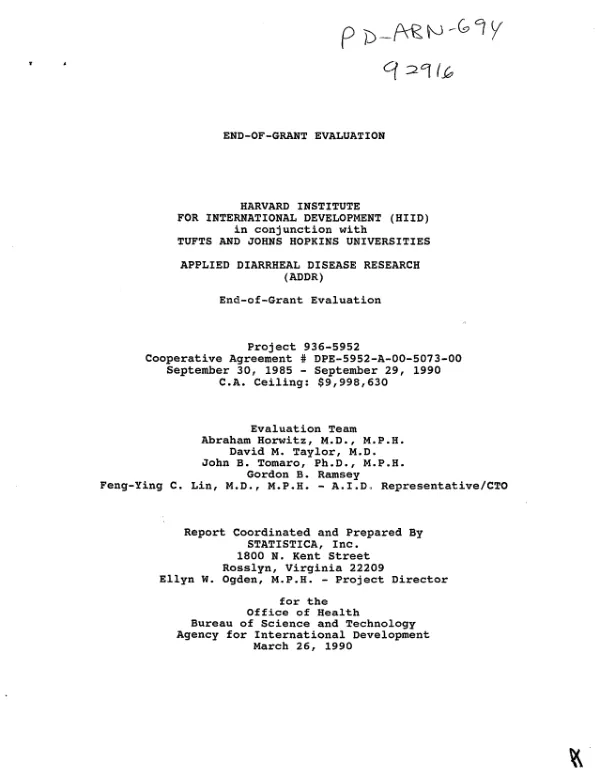
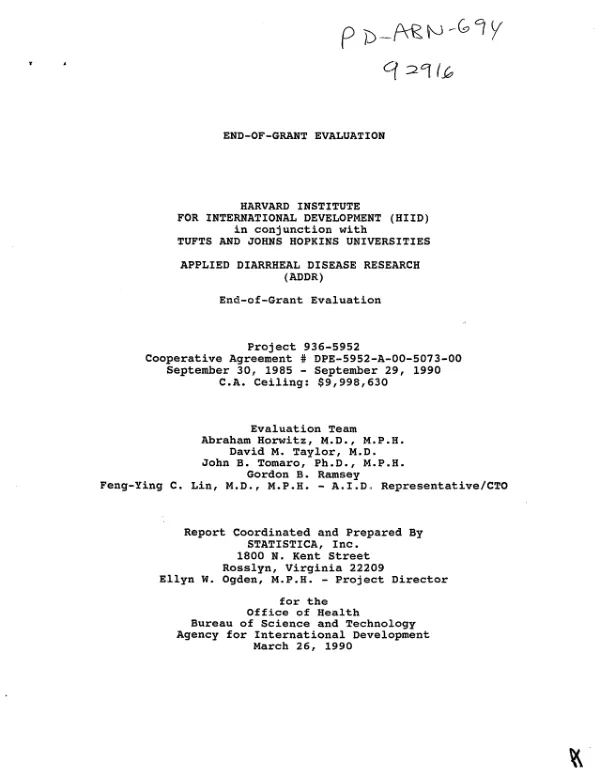
![End-of-project review : applied diarrheal disease research [ADDR] project of the Harvard Institute for International Development in conjunction with Johns Hopkins University and Tufts University](https://covers.devme.ai/gen/6401.webp)