USAID. MISSION TO THAILAND
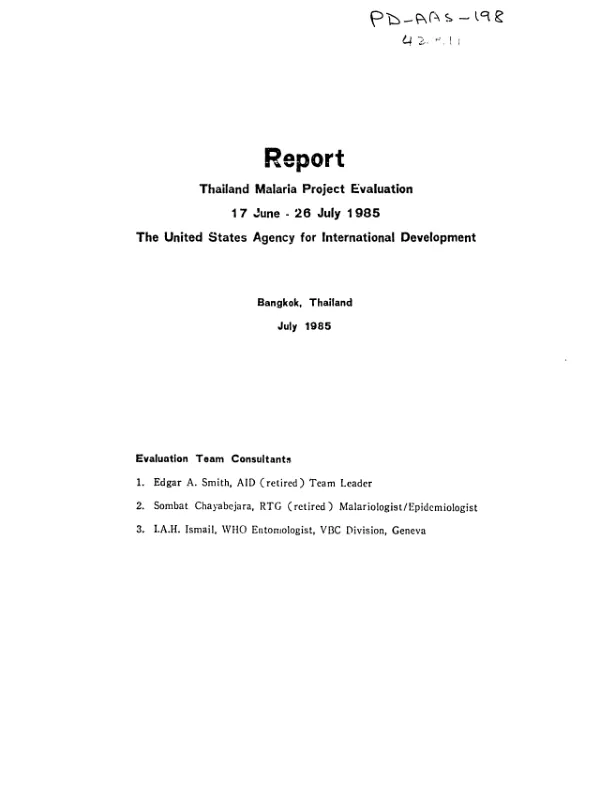
Report, Thailand malaria project evaluation
Evaluates project to assist the Royal Thai Government's (RTG) nationwide malaria control (MC) program.
Smith, Edgar A.|Chayabejara, Sombat|Ismail, I. A. H. · 1985
Sign in to readA free account is required to download.
Abstract
Ex post evaluation is based on document review, site visits, and interviews with regional officials, volunteers, and field workers. During the project's 5-year life (1979-84), the MC program made substantial progress, the project assisting all levels of the RTG's Malaria Division, with primary emphasis on interventions at the first point of contact in the MC delivery system. TA was more than adequate, while training, especially inservice and pre-service training, and facility construction and renovation resulted in a tremendous expansion of the malaria clinic and malaria village volunteer network. The provision of commodities, health education materials, and motorcycles also benefited the program, although the vehicle overhaul effort proved disappointing. Of 8 operational research projects, anti-malaria drug studies and a study of an MC early warning system had immediate or potential value, but the rest were of minimal value. Greater benefit might have been derived from the use of more short-term consultants, especially in the areas of applied field research and the use of supplementary and alternative vector control measures. Despite progress, population migration and the persistent resistance to drugs of P. falciparum retard MC effectiveness; the malaria transmission rate remains high in certain control areas. Several program areas require attention. These include, inter alia: (1) a weak residual house spraying program (due for the most part to shortage of insecticides); (2) the need to improve operational entomology, with special attention to monitoring vector susceptibility to DDT and fenitrothion and studying malaria foci in regard to time and place; (4) the need for academically trained malariologists; and (5) the need to replace unfit vehicles and to provide zone and sector offices with permanent buildings. Stress is laid on strengthening research capabilities, especially of the Field Applied Research Station. Recommendations address these and other areas and stress the need to develop an overall plan to improve the program.