USAID. MISSION TO BOLIVIA
Reproductive health services
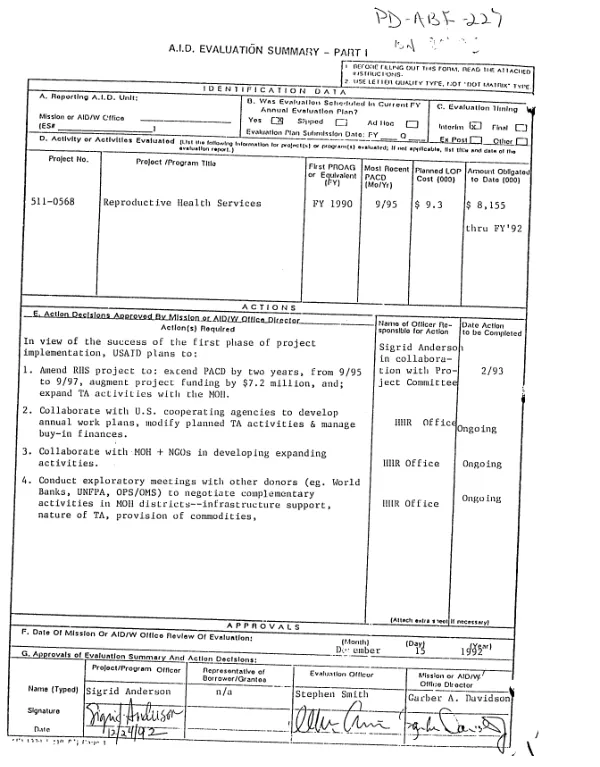
Summarizes interim evaluation (PD-ABF-008) of a project to increase the accessibility and quality of family planning (FP) services in Bolivia.
1992
Sign in to readA free account is required to download.
Abstract
The evaluation covered the period 1990- 11/92. Although FP is a sensitive topic in Bolivia, the political climate for FP has improved, and the project has achieved some notable successes. The National Social Security Institute has begun a major effort to include FP services in its network of hospitals and clinics; FP training centers have been established to train staff of various institutions; the Ministry of Planning"s Population Policies Unit has produced an impressive series of population and reproductive health studies (which have contributed to the more favorable climate for FP); several NGO"s, including PROSALUD, Fundacion San Gabriel, and the Center for Investigation, Education, and Services (CIES), have made important progress in strengthening their FP programs; and the project"s social marketing program has exceeded its goals for sales of orals and is ready to move into rural areas and to begin pilot condom sales through itinerant merchants and street vendors. The National Coordinating Committee for Reproductive Health, established as a result of a USAID/B initiative, has been an effective mechanism for coordinating project activities. Assistance to the Ministry of Health (MOH) -- which did not even offer FP until 1989 -- has been limited, since the UN Fund for Population Activities/Pan American Health Organization (UNFPA/PAHO) was to be the principal source of assistance to the MOH. Recently, however, the MOH requested USAID"s help in developing FP services in selected districts where other donors are supporting primary and child health care services. Important cross-cutting issues are: the relative priority of urban vs. rural target populations; the appropriate balance of support for public agencies and NGO"s; measures to improve logistics and service statistics; needed modifications in information, education, and communication (IEC) strategies; opportunities for linking the project with activities in health and in AIDS/sexually transmitted disease prevention; measures to reduce medical barriers to contraception; and research and training needs. Key action decisions are to: (1) extend the PACD 2 years to 9/97, augment funding by $7.2 million, and expand TA activities with the MOH; and (2) conduct exploratory meetings with other donors (e.g., World Bank, UNFPA) to negotiate complementary activities in MOH districts.
Related documents
Documents in this collection
![Midterm evaluation of the PROFAMILIA [Asociacion Pro-Bienestar de la Familia Nicaraguense] diversification, sustainability, and social marketing grant : executive summary](https://covers.devme.ai/gen/72986.webp) 2001
2001USAID DEC
Midterm evaluation of the PROFAMILIA [Asociacion Pro-Bienestar de la Familia Nicaraguense] diversification, sustainability, and social marketing grant : executive summary
Open record![Midterm evaluation of the PROFAMILIA [Asociacion Pro-Bienestar de la Familia Nicaraguense] diversification, sustainability, and social marketing grant](https://covers.devme.ai/gen/5467.webp) 2001
2001USAID DEC
![Innovations in family planning services [IFPS] project : midterm assessment report](https://covers.devme.ai/gen/5707.webp)
![Mid-term evaluation of the USAID/DR [Dominican Republic] family planning and health project (517-0259)](https://covers.devme.ai/gen/53179.webp)