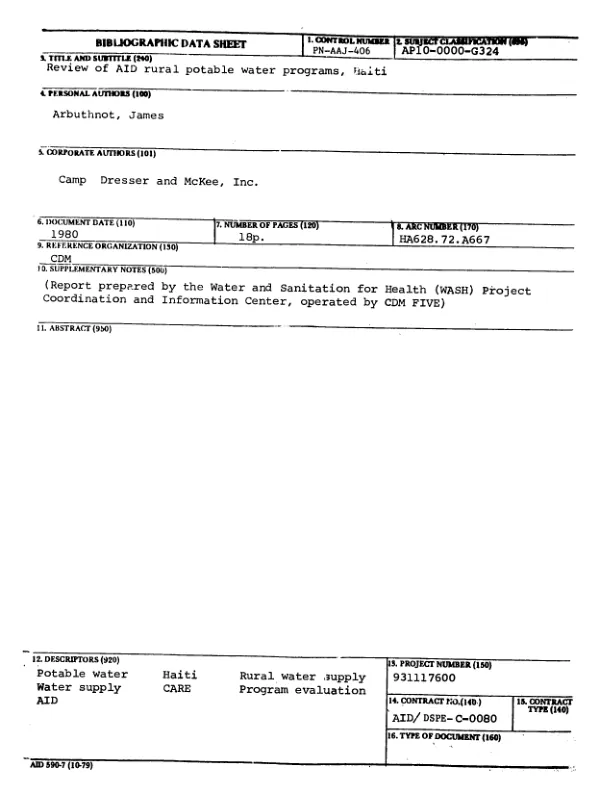
CAMP DRESSER AND MCKEE, INC. (CDM)
Reprogramming of the rural sanitation project in Bolivia
Evaluates rural sanitation project in Bolivia with a view to reactivating the project (A.I.D.
Stevens, Charles S. · 1982
Sign in to readA free account is required to download.
Abstract
support was withdrawn in 7/80). Evaluation, funded under project 9311176, covers the period 7/77-6/82 and is based on document review, site visits, and discussions with project, USAID/B, and Government of Bolivia (GOB) personnel. Due mainly to limited administrative capability on the part of the GOB"s Division of Environmental Sanitation (DES) and inadequate GOB counterpart funding, project implementation prior to the funding freeze was unsatisfactory, with only 6 of 200 planned water systems and 500 of 7,600 planned latrines having been completed, all in the Department of Cochabamba. In the Department of Chusquisaca, no construction was initiated. Since the freeze, the DES has made progress in solving its administrative problems, but lack of funding and resultant lack of materials has limited water system construction. In mid-1981, A.I.D. made an interim loan for material purchases to maintain a minimum level of project activity; 19 water systems have now been completed and 43 are projected by 12/82. Review of available funding indicates that an additional 130 water systems can be funded. To meet this goal, the DES is proposing four additional field offices in Cochabamba and one in Chuquisaca. Each office, when fully staffed, will be responsible for building 10 water systems annually. A contract extension to 6/85 will permit construction of the 130 systems. The following conditions should be met if the project is to be reactivated: (1) submission by the DES of a revised implementation plan reducing the proposed extension from 4 to 3 years; (2) decentralizion of DES responsibilities and provision of logistic support to DES regional offices; (3) internal DES reorganization to improve its technical, financial, and administrative capabilities (to include purchasing and procurement capability); (4) simplification of the DES information and accounting systems; (5) purchase of additional well drilling equipment, vehicles, and materials; and (6) increased counterpart contribution.