USAID DEC
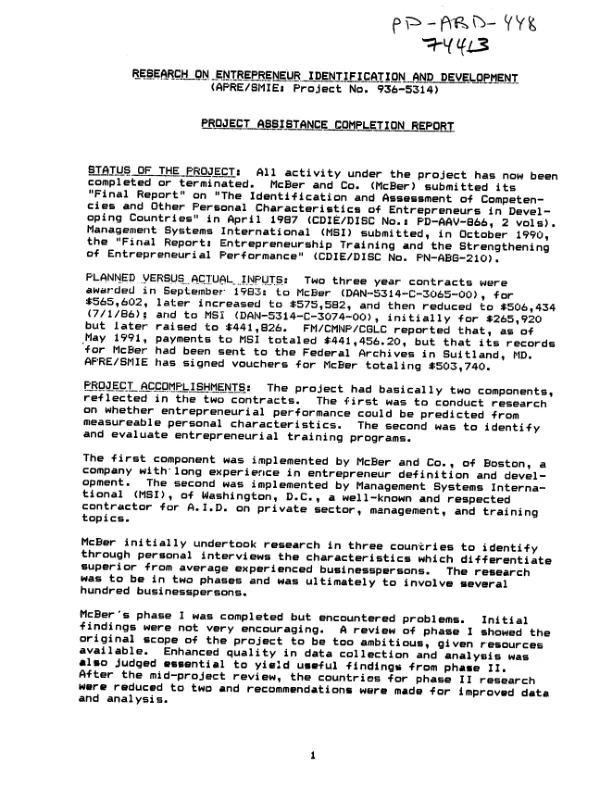
Research on entrepreneur identification and development (APRE/SMIE : project no. 936-5314) -- project assistance completion report
Sign inUSAID. BUR. FOR ASIA AND PRIVATE ENTERPRISE. OFC. OF SMALL, MICRO AND INFORMAL ENTERPRISE
Research on entrepreneur identification and development (APRE/SMIE : project no. 936-5314) -- project assistance completion report
PACR of a project (1983-1990) to (1) conduct research on predicting entrepreneurial performance and (2) evaluate entrepreneurial training programs.
1991
Sign in to readA free account is required to download.
Abstract
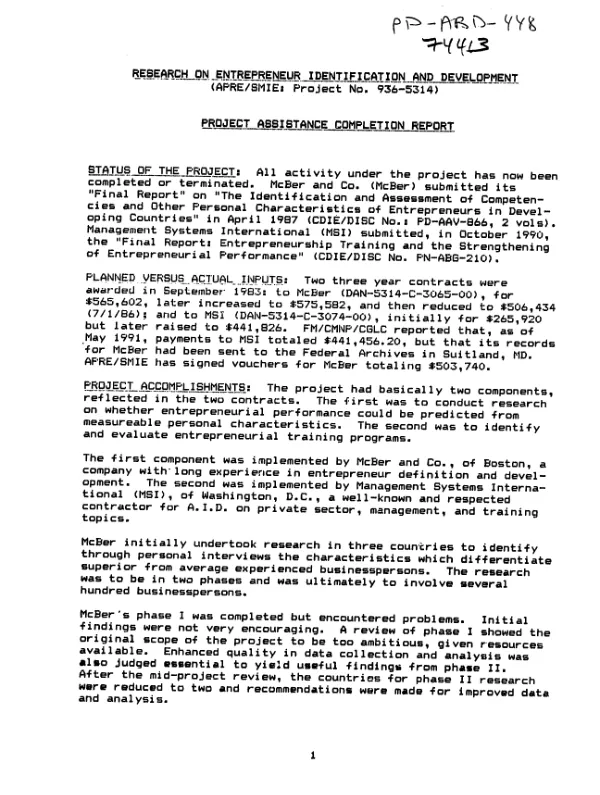
The first component, implemented by McBer and Co., was designed to involve research in three countries to identify (through several hundred personal interviews) the characteristics that differentiate superior from average experienced businesspersons. This plan proved too ambitious, and research was reduced to two countries. McBer's analyses yielded only a limited ability to predict business performance from a knowledge of personal characteristics. The initial working assumption that superior businesspersons would have higher "achievement motivation" was not demonstrated in the data. Possible correlations were found between success and up-to-date business knowledge as well as good management information/monitoring patterns. The second component, carried out by Management Systems International, provided modest evidence that it is possible to affect business performance through entrepreneurial training. There is no evidence in these analyses, however, as to which forms of training are most cost-effective or that such training is likely to be any more effective than other form of technical, capital, or policy reform assistance to the small enterprise sector. Three major lessons were learned. (1) The study of entrepreneurial psychological characteristics appears complex, costly, and unlikely to yield more than modest findings. (2) The present analysis is not an adequate basis for a decision on whether to mount a major program of entrepreneurial training in developing countries. (3) Project evaluation should be contracted to a different party than the implementing agent.
Related documents